article
XF4U-4 Corsair Model Building: Advanced Upgrade and Precision Finish
The XF4U-4 Corsair model is one of those builds that stands out immediately if done right — and looks sloppy if done in a hurry. It’s not an “easy project,” but if you approach it strategically, the result can be exhibition-worthy.
The basis for this project is the Tamiya 1/48 scale kit. Realistically, there’s no other serious option for a proper XF4U-4 Corsair model at this scale. The kit has excellent fit and geometry, but it doesn’t fully replicate the -4 version, so aftermarket use is not a luxury — it shouldn’t be.
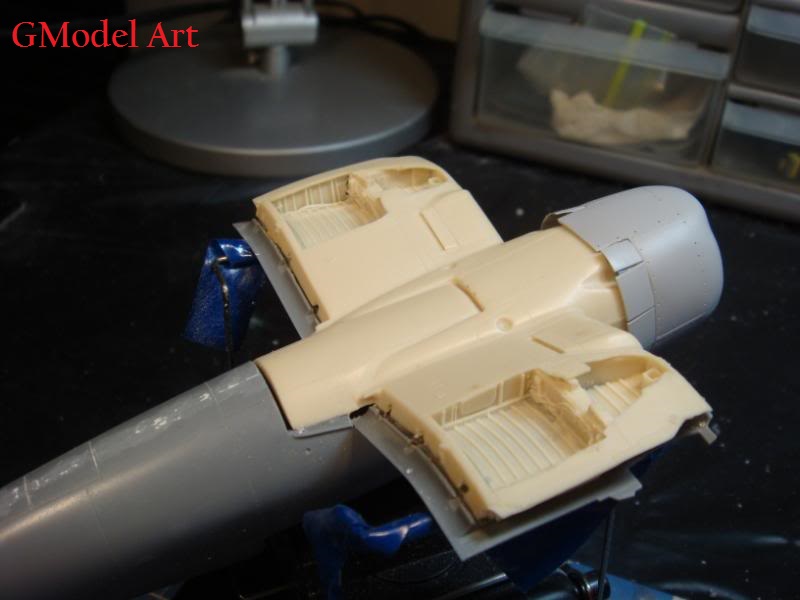
That’s where CMK’s 4064 conversion set comes in, which is the core of the conversion. It offers a new front engine structure, improved wheel wells with intense detail, and a full cockpit with upgraded canopy. In effect, it turns the basic kit into a real XF4U-4 Corsair model. The only area that needs attention is the wingtips, where you try and sand them properly to “tie” them cleanly. It’s not difficult, but if you leave it sloppy, it will betray the final result.
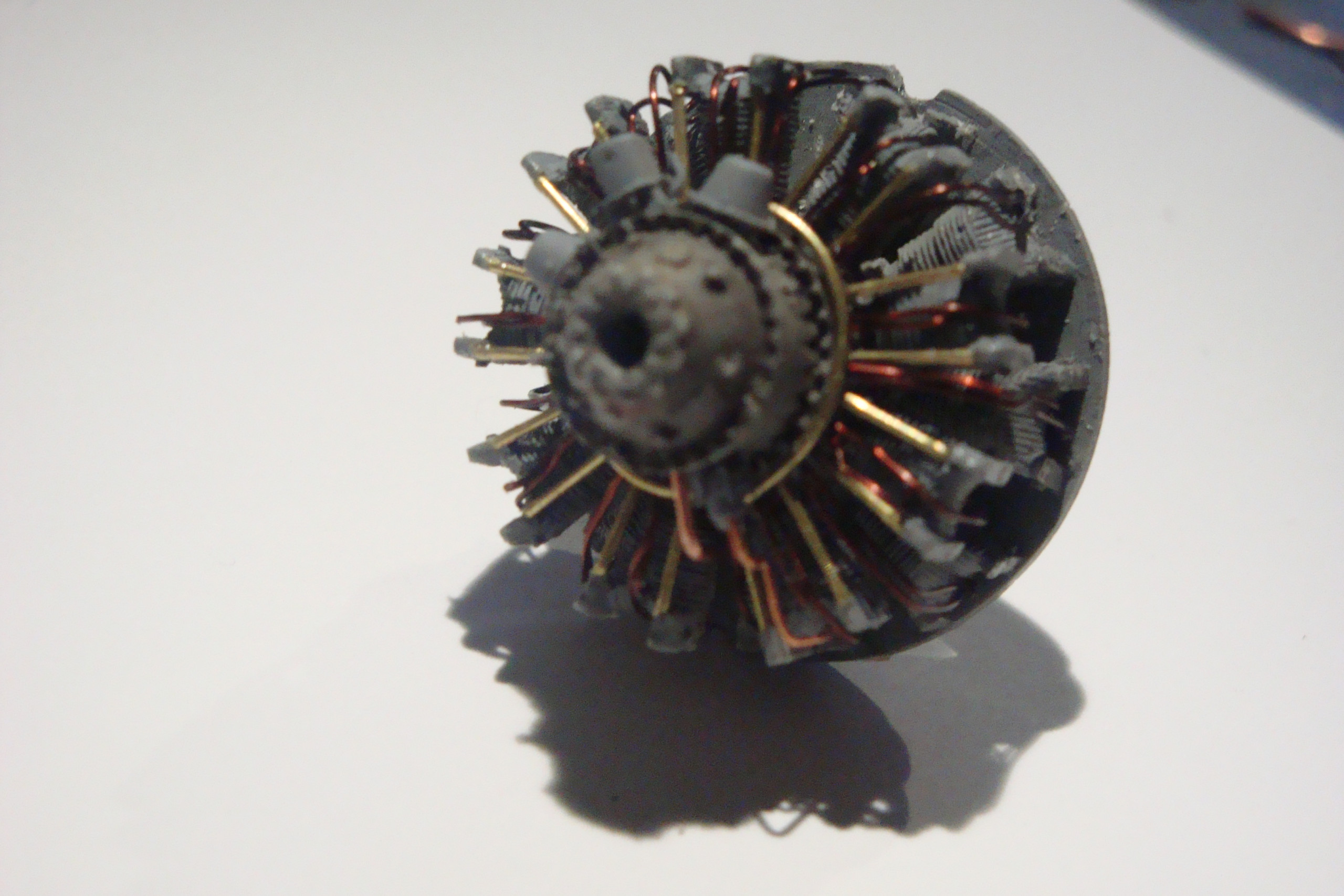
For the engine, the Quickboost Pratt & Whitney R-2800-42W (set 48421) was used, and there is no dilemma here. If you want an XF4U-4 Corsair model that stands out seriously, the engine must have depth and clean detail. This particular upgrade does exactly that — it fills the front of the model and draws the eye without exaggeration.
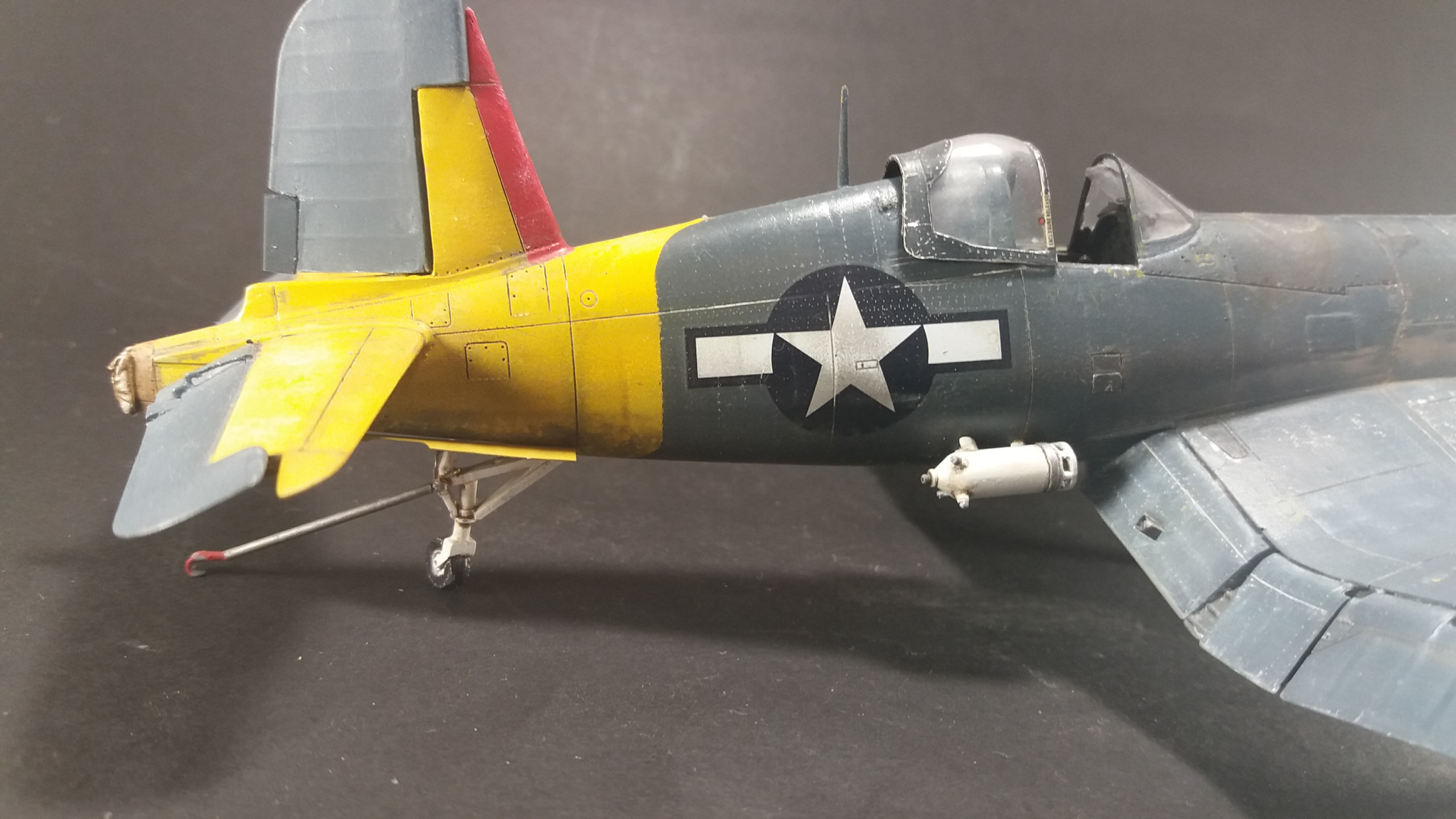
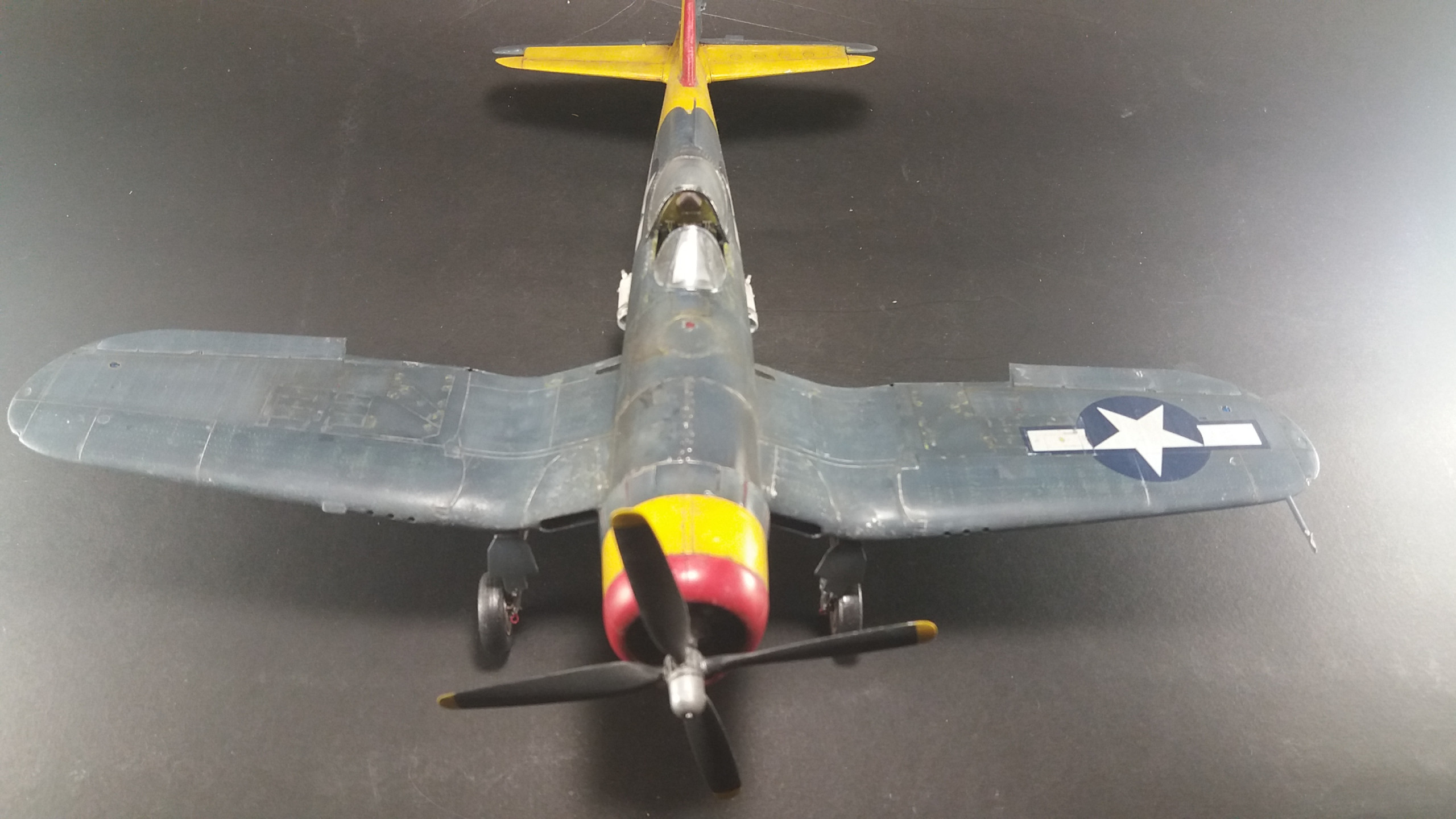
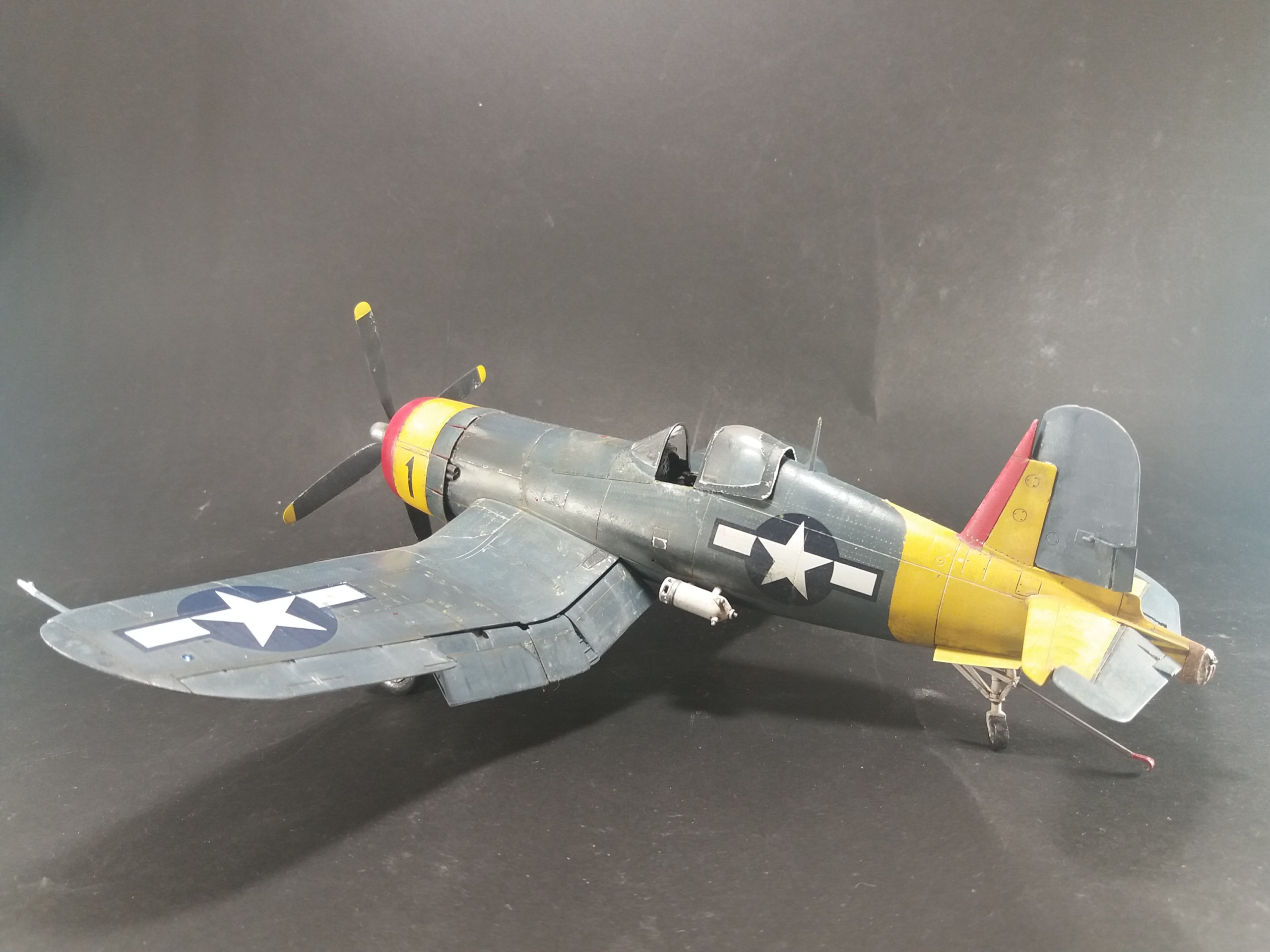
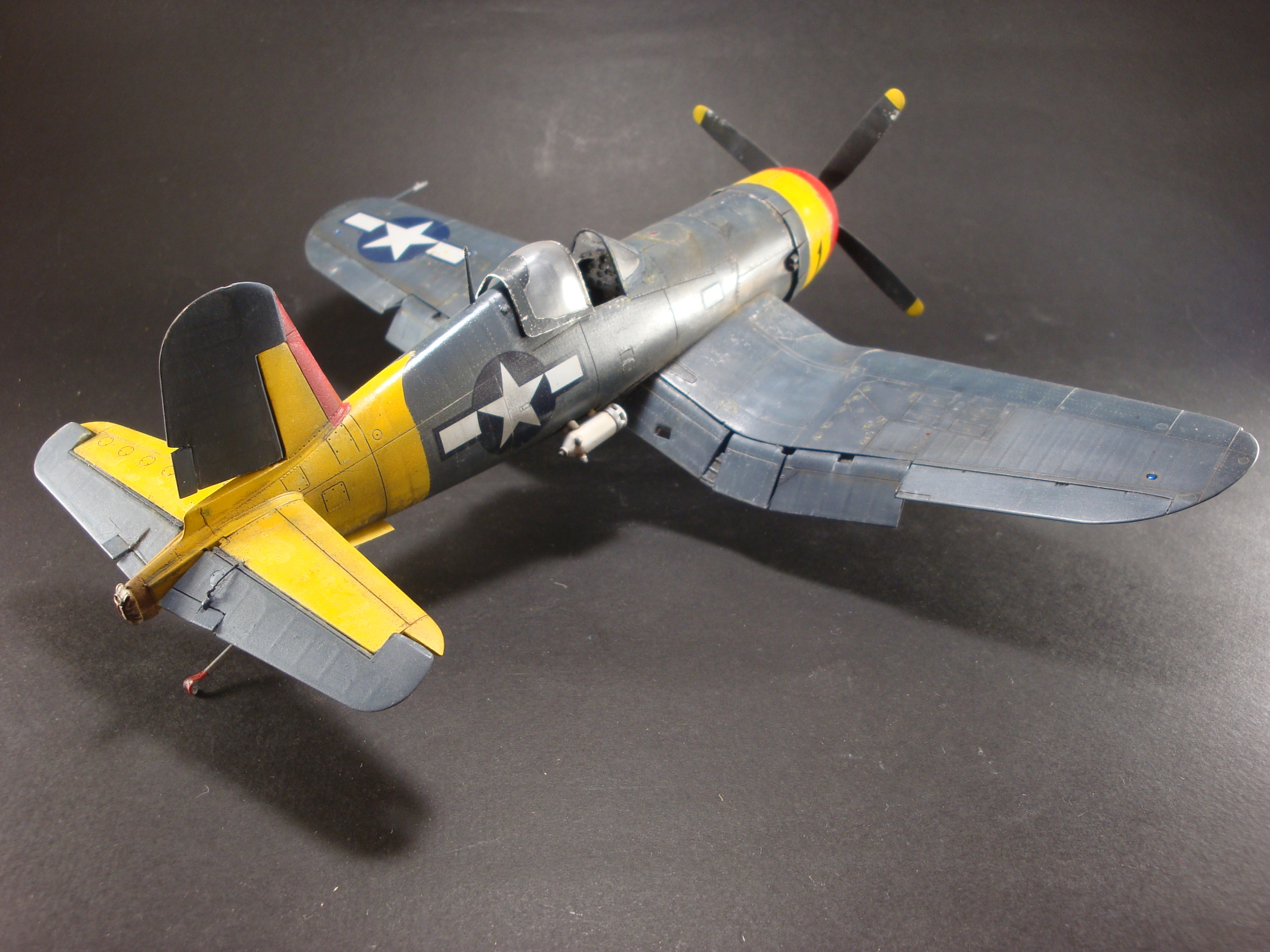
The construction philosophy was based on a late World War II aircraft, circa 1944–1945, in a state of maintenance and not intense operational wear and tear. This is important, because it determines all subsequent choices. A resin parachute from a Verlinden kit was added, the rudders were cut and repositioned to provide movement, while the landing hook was lowered manually. In addition, JATO units from a Tamiya F-84 kit were installed, giving a more “aggressive” image without departing from the logic of the era.
Surface preparation began with engraving on the rivets, so that the model would gain depth before painting. This was followed by priming with Vallejo Surface Primer Grey, which acts as a neutral base and helps the subsequent layers to “bond” properly. From there, the painting was done with logical layering and not simple coverage.
Alclad ALC-101 Aluminum was first applied, creating a metal base that would be discreetly visible in areas of wear. COLOURCOATS US Navy Blue (FS 15042) was then used for the bulk of the aircraft, while Deck Blue (FS 35042) was added around the perimeter of the panels to break up the monotony and add visual interest. Details were rendered with Tamiya XF-3 (FS 13538) and XF-7 (FS 11136), keeping the colors vibrant but controlled.
To keep things focused, here are the base colors with FS matching:
| Paint | Description | FS Code |
|---|---|---|
| Alclad ALC-101 Aluminum | Base metallic layer | FS 17178 |
| COLOURCOATS US Navy Blue (US-08) | Main fuselage color | FS 15042 |
| Deck Blue (US-10) | Panel variation | FS 35042 |
| Tamiya XF-3 Yellow | Details / markings | FS 13538 |
| Tamiya XF-7 Red | Details / markings | FS 11136 |
The “Black Ace” feature was done with masking and airbrushing, not decals, to blend naturally into the model and avoid a “sticker look”.
Weathering was kept to a minimum. This particular XF4U-4 Corsair model does not represent a worn-out battlefield aircraft, but a well-maintained machine. Light scraping was done to show the aluminum underneath and minor damage only at contact points. This keeps the result realistic and not overdone — something many modelers end up ruining.
The final finish was done with MR Hobby Clear H-30, while a 50/50 mix of H-20 and H-30 was used to achieve a proper semi-gloss effect. This is critical, because the finish is what visually “locks” the whole job in and determines whether the model will look plastic or real.
Overall, a successful XF4U-4 Corsair model is not just a matter of technique, but of choice. If you choose the right base, invest in the right upgrades, and maintain discipline with paint and weathering, the result is not just good — it’s a level that stands out.
Weathering with AK Interactive Washes – AK 2076 & AK 2073
XF4U-4 Corsair