article
US Navy Blue Gray / Light Gray Camouflage (1941–1943): Origins, Aircraft and Real-World Application
Introduction
The Blue Gray over Light Gray camouflage scheme used by the United States Navy during the early years of World War II represents a critical transition from pre-war visibility to wartime survival. Introduced out of operational necessity rather than theoretical perfection, this scheme became the defining visual identity of US naval aviation during the first half of the Pacific War.
This article explores how the scheme emerged, which aircraft carried it—including seaplanes—and how environmental and industrial factors shaped its real appearance.
How the Camouflage Scheme Was Developed
On December 30, 1940, the Bureau of Aeronautics issued a directive that fundamentally changed naval aviation camouflage. All carrier-based aircraft were to be painted in Non-Specular Light Gray, replacing earlier aluminum and yellow finishes that were highly visible and tactically obsolete.
However, combat experience quickly revealed a flaw: aircraft were still easily spotted from above. To address this, a second color—Non-Specular Blue Gray—was introduced for upper surfaces.
This evolved into a two-tone camouflage system:
- Upper surfaces: Blue Gray
- Undersurfaces: Light Gray
The transition became official on:
- August 20, 1941 (Battle Fleet)
- October 13, 1941 (entire fleet)
This scheme remained standard until mid-1943, when it was replaced by the tri-color camouflage.
Operational Logic of the Scheme
The effectiveness of the scheme was based on simple visual principles:
- Blue Gray reduced contrast against the ocean when viewed from above
- Light Gray minimized visibility against the sky when viewed from below
It was not a perfect system, but it significantly improved survivability in open-sea combat conditions.
Aircraft That Used the Blue Gray / Light Gray Camouflage (1941–1943)
The following is a consolidated list of known US Navy and US Marine Corps aircraft that operated with this camouflage, including fighters, bombers, torpedo aircraft, and seaplanes:
- Grumman F4F Wildcat
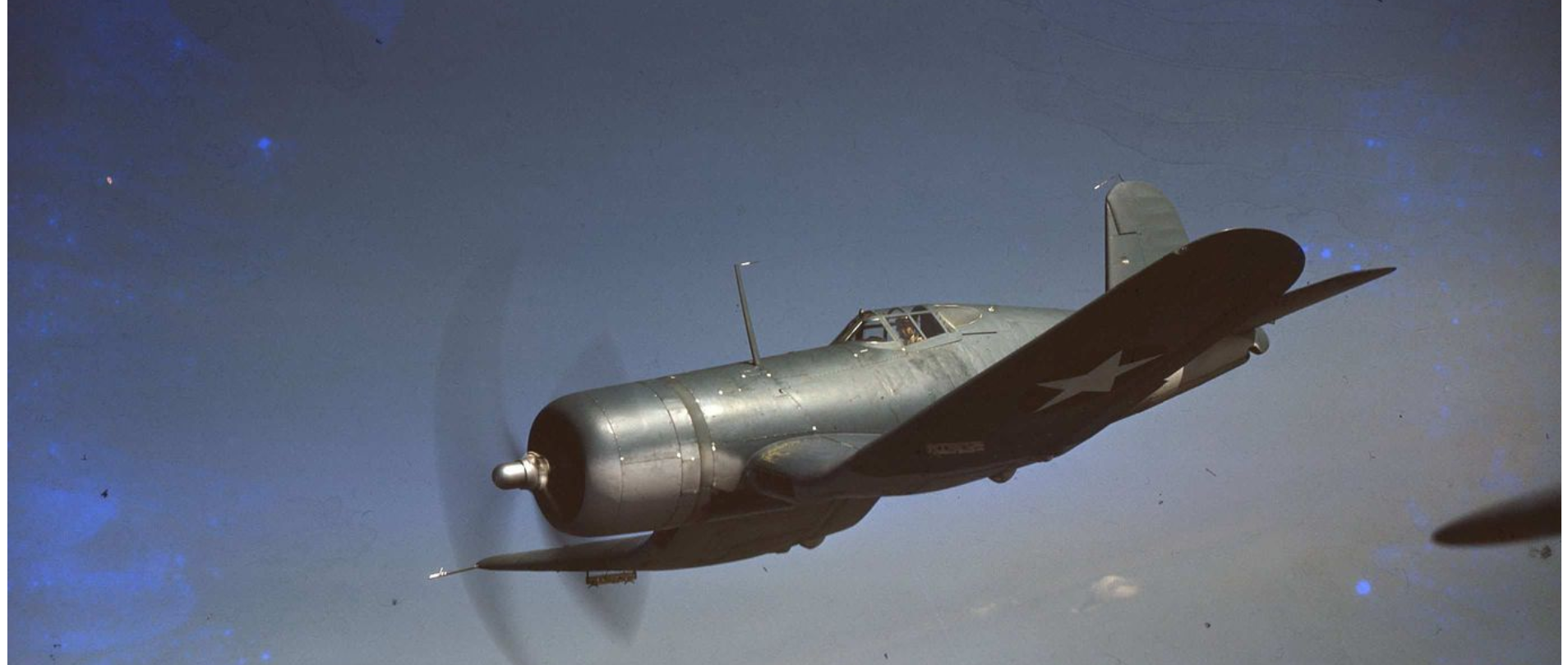
- Vought F4U-1 Corsair
- Grumman F2A Buffalo
- Grumman F3F (late service aircraft repainted early war)
- Douglas SBD Dauntless
- Curtiss SB2C Helldiver
- Douglas TBD Devastator
- Grumman TBF Avenger
- Consolidated PBY Catalina
- Vought OS2U Kingfisher
- Curtiss SOC Seagull
- Curtiss SO3C Seamew
- North American B-25 Mitchell
This list reflects the widespread adoption of the scheme across virtually all operational naval aviation roles during the early Pacific War.
Historical Context and Combat Use
The Blue Gray / Light Gray camouflage was dominant during key early-war operations:
- Attack on Pearl Harbor (transition phase)
- Battle of Midway
- Guadalcanal Campaign
These battles demonstrated both the strengths and limitations of the scheme, particularly under harsh Pacific conditions.
Color Specifications and Technical Background
The colors were defined under US Navy specification M-485 (1940) and its revision M-485a (1941).
Non-Specular Light Gray
- Warm-toned gray with slight yellowish tint
- Approximate comparison: FS 36440
- Often appears lighter in photographs due to lighting and film exposure
Non-Specular Blue Gray
- Complex blue-gray tone with no exact modern equivalent
- Approximate comparison: FS 35189 (not fully accurate)
Two main variations existed:
- Early version: more blue, highly prone to fading
- Later version: darker, more gray, better durability
Factory Production and Paint Characteristics
One of the most overlooked aspects of this camouflage is variability at the manufacturing level.
Different paint suppliers produced batches with:
- Slight tonal differences
- Variations in pigment density
- Inconsistent durability
The “Non-Specular” finish was intended to be matte, but in practice:
- It often had a subtle sheen when new
- It degraded into a chalky, flat surface over time
Environmental exposure accelerated these effects:
- UV radiation caused rapid fading, especially in the Pacific
- Salt air contributed to surface breakdown
- Humidity created staining and uneven wear
Field Application and Visual Inconsistencies
Unlike later standardized camouflage systems, this scheme was applied with minimal precision:
- Freehand spraying without strict masking
- Soft and irregular demarcation lines
- Unit-level variations in pattern
Special structural features also affected application:
- Folding wings were sometimes painted differently depending on exposure
- Repaired aircraft often displayed mismatched repainting
- Engine cowls and panels could differ in tone from the rest of the airframe
The result was a highly inconsistent and organic appearance across operational aircraft.
Weathering and Fading in Combat Conditions
The Pacific environment had a dramatic effect on the Blue Gray color:
- Rapid bleaching under intense sunlight
- Transition from blue-gray to pale gray tones
- Uneven fading across panels
This created a “patchwork” effect that is clearly visible in period photographs.
From a modeling perspective, this is not a flaw—it is the defining characteristic of the scheme.
Paint Guide for Scale Modelers
Light Gray
Any high-quality paint matched to FS 36440 is generally acceptable for modeling purposes.
Blue Gray
More complex to reproduce accurately. Available options include:
- Model Master
- Colourcoats
- Mr. Paint
- AK Real Color
- Vallejo 71.109 (questionable accuracy)
Important considerations:
- Some paints represent faded versions rather than fresh application
- A realistic finish often requires custom mixing and weathering
Conclusion
The Blue Gray / Light Gray camouflage was not a perfect system, but it was a necessary and effective adaptation to the realities of naval warfare. Its variability, rapid aging, and inconsistent application make it one of the most challenging—and rewarding—schemes to replicate accurately.
For historians, it represents a transitional phase in military aviation doctrine. For modelers, it offers something even more valuable: freedom within realism.
| NS Light Grey | NS Blue Grey (1) | NS Blue Grey (2) | |
| Schemes | |||
| General (Dec 40) | Overall | ||
| General (Aug 41) | Lower | (Upper) | (Upper) |
| Color matches | |||
| Gunze Aqueous | – | – | – |
| Gunze Mr Color | – | C367* | C367* |
| Humbrol | – | – | – |
| Model Master | – | 2055 | 2055 |
| Revell | – | – | – |
| Tamiya | – | – | – |
| Vallejo Model Air | 71.298* | (71.109) (?) | (71.109) (?) |
| Vallejo Model Color | – | (70.904) | (70.904) |
| AKAN | – | – | – |
| AK Interactive | – | – | – |
| AK Real Colors | RC255 | RC256 | RC256 |
| AMMO by Mig | – | – | – |
| Colourcoats | ACUS05 | ACUS06 | ACUS06 |
| Hataka | – | HTK-_218* | HTK-_218* |
| Lifecolor | – | UA 038* | UA 038* |
| Mission Models | – | (MMP-061) | (MMP-061) |
| Mr Paint | MRP-134 | MRP-133 | MRP-133 |
| Xtracolor | – | (X162) | (X162) |
| Xtracrylix | – | – | – |
WWII Pacific Theater Pilot Gear & Uniforms: A Modeling Guide