article
Vought F4U-1 “Birdcage” Corsair
How the Early Corsair Was Built, Primed and Painted on the Vought Factory Assembly Line
The Vought F4U-1 Birdcage Corsair represents the earliest production form of one of the most important American fighters of World War II. Before the later raised-cockpit Corsairs became familiar to historians and modelers, the first production aircraft left the Chance Vought factory with the distinctive framed canopy that gave this early version its famous “Birdcage” nickname.
This article focuses exclusively on the early F4U-1 Birdcage Corsair during its production period. It examines when production began, how the aircraft evolved during the early production run, how its major components were assembled, which primers were used, and how the aircraft was painted.
The objective is practical as well as historical: to help scale modelers reproduce an early F4U-1 exactly as it could appear inside the Vought factory, rather than depicting a fully operational Corsair with Pacific Theater weathering.
1. From the XF4U-1 Prototype to the Production F4U-1
The story of the Corsair began with the XF4U-1 prototype, Bureau Number 1443, which made its first flight on 29 May 1940. By the end of that year, the prototype had exceeded 400 mph, making the Corsair one of the fastest single-engine fighters of its time.
In June 1941, the U.S. Navy ordered 584 F4U-1 production aircraft. The production version differed considerably from the prototype. The cockpit was moved approximately three feet aft, additional fuel capacity was introduced, the armament was changed to six .50-caliber machine guns, and pilot armor and self-sealing fuel tanks were incorporated.
These changes were not simply cosmetic. They affected the structure, weight distribution, internal systems and, ultimately, the way the aircraft behaved during carrier operations.
The result was the first production F4U-1 Corsair.
2. When Did F4U-1 Production Begin?
The first production-standard F4U-1 made its maiden flight on 24 June 1942. The U.S. Navy received its first Corsair on 31 July 1942, while the initial production run continued to expand during the second half of the year.
By 31 December 1942, the Navy had accepted 178 F4U-1 aircraft.
Production was initially relatively slow and continuously evolving. The early Corsair was not a completely frozen design; changes were introduced while aircraft were already moving through production.
This is essential when studying factory photographs. Two F4U-1 aircraft built only months apart could contain differences in equipment, structure or external details.
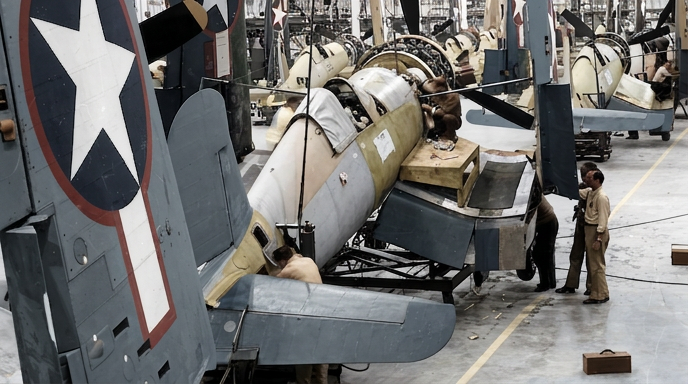
The National Archives preserves photographs of the actual Chance Vought production line at Stratford, Connecticut, including F4U-1 Corsairs being assembled in March 1943. One photograph, catalogued as 80-G-412660, shows F4U-1 fighters on the assembly line while workers tighten fittings on the forward fuselage.
Another photograph, 80-G-412683, shows an F4U-1 undergoing post-manufacture wing-folding tests in March 1943.
These photographs are particularly valuable because they allow us to study the Corsair not simply as a finished aircraft, but as a product moving through an industrial manufacturing process.
3. Why Was It Called the “Birdcage” Corsair?
The earliest production F4U-1 used a distinctive multi-framed canopy. The numerous structural frames surrounded the transparent panels and created the appearance that led to the unofficial nickname “Birdcage.”
The canopy was not the only issue facing the early Corsair.
The cockpit had been moved aft, leaving the pilot behind the enormous engine and long forward fuselage. The resulting forward visibility was poor, particularly during carrier approaches. The aircraft also exhibited difficult low-speed characteristics and a tendency to bounce during landing.
The Navy therefore initially directed many F4U-1s toward land-based Marine operations rather than carrier squadrons. Marine Fighting Squadron VMF-124 began receiving Corsairs in February 1943, while the type was increasingly employed from land bases in the Solomon Islands.
The Birdcage canopy therefore belongs to a very specific phase in Corsair development: the first operational production generation of the aircraft.
4. The Corsair Was Built as a Series of Subassemblies
One of the most important points for understanding factory photographs is that the Corsair should not be imagined as a completely assembled airframe that was simply painted from nose to tail at the end.
The manufacturing process involved numerous separate components and assemblies.
These included:
fuselage structures
center-section and folding outer wing assemblies
horizontal stabilizers
vertical fin and rudder
elevators and ailerons
flaps and associated mechanisms
landing gear assemblies
cowling components
cockpit components
engine installation
canopy components.
This production method explains why photographs can show apparently contradictory finishes on the same aircraft.
One component may already be finished in its exterior color while another section of the fuselage is still covered by primer or remains unfinished.
The National Archives photographs provide direct evidence of F4U-1 aircraft being worked on at different stages of assembly, while a separate March 1943 color photograph records workers assembling the Pratt & Whitney R-2800 used by the Corsair. The engine is described by the Naval History and Heritage Command as appearing “factory fresh.”
For a diorama, this distinction is crucial.
A factory Corsair should look like a collection of completed and partially completed assemblies coming together—not like an operational aircraft stripped for maintenance.
5. The First Protective Coating: Zinc Chromate Shop Primer
The best evidence for understanding the Corsair’s primer system comes from the Vought-Sikorsky F4U-1, FG-1, F3A-1 Erection and Maintenance Instructions, dated 7 September 1942.
The materials list identifies:
Zinc Chromate Primer — USN Specification AN-TT-P-656
and separately:
Tinting Medium — Indian Red Paste, USN Specification TT-I-511.
For raw aluminum construction, the instructions describe a first protective coat known as the Shop Primer Coat.
This was applied thinly and produced the familiar yellow-green appearance associated with zinc chromate primer.
The simplified production sequence can therefore be represented as:
Raw Aluminum → Yellow Zinc Chromate Shop Primer → Additional Protective Treatment / Finish
This is an important distinction.
The entire fuselage was not simply painted Salmon from the beginning.
Different materials and areas could require different protective treatments.
6. How Vought Produced the Famous Salmon Primer
The famous Vought Salmon Primer was not simply a pink paint applied for appearance.
According to the surviving F4U-1 technical documentation, Indian Red pigment was used as a tinting medium for zinc chromate primer. The resulting material was referred to as Tinted Primer.
The basic concept was:
Yellow Zinc Chromate + Indian Red Tinting Medium = Tinted Zinc Chromate / Vought Salmon
The tint also provided a visual distinction between coats, allowing workers to see whether the required coverage had been achieved.
The historic material was not a bright modern pink. References to surviving material and period documentation describe it as a muted, orange-brown or salmon-colored tinted zinc chromate.
For scale modeling, this distinction is extremely important.
Vought Salmon should not be represented as candy pink, magenta or highly saturated salmon.
7. Was the Entire Interior Salmon?
No.
This is one of the most common oversimplifications in Corsair modeling.
The production documentation identifies different protective and finishing treatments depending on the component and material. Certain magnesium-alloy components, for example, were specified to receive multiple coats of zinc chromate primer followed by tinted primer.
Research into surviving F4U-1 components and recovered wreckage has also provided evidence for Salmon primer on structural interior areas. However, not every interior component should automatically be painted Salmon.
The most useful interpretation for the modeler is therefore:
Salmon = a documented tinted protective primer used on appropriate structural areas.
It is not synonymous with:
“everything inside the Corsair was pink.”
That distinction should guide every factory-diorama project.
8. The Cockpit Was Different
The cockpit had its own specified finish.
The F4U-1 materials list identifies:
Lacquer — Dull Dark Green
for the cockpit interior.
Therefore, a historically based early Birdcage Corsair should distinguish between:
Cockpit → Dull Dark Green
and
Other structural interior areas → zinc chromate / tinted zinc chromate according to the applicable protective schedule.
This is another reason why simply painting the entire interior Salmon produces an inaccurate result.
9. Engine Area, Cowling and Wheel Bays
The engine and the surrounding airframe structure should also be treated as separate areas.
The Pratt & Whitney R-2800 was installed as a major mechanical assembly, while the surrounding structure had its own primer and finish requirements.
Historical research into the F4U-1 documentation indicates that the wheel bays, engine cowling and accessory cowling areas were treated differently from the general structural interior, including the use of the underside Light Gray finish in these areas. Surviving Corsair components have also produced evidence of Salmon beneath later finishes in some locations.
Therefore, the modeler should not automatically paint:
engine compartment = Salmon
or
wheel bay = Salmon
without considering the particular production feature being represented.
For a factory diorama, photographic evidence of the exact aircraft and production stage should always take priority.
10. External Paint on the Early F4U-1
The first F4U-1s carried the early U.S. Navy two-color camouflage scheme:
Upper Surfaces
Non-Specular Blue Gray
Lower Surfaces
Non-Specular Light Gray
For scale modeling, modern references commonly use approximately:
FS 35189 — Non-Specular Blue Gray
and
FS 36440 — Non-Specular Light Gray
These Federal Standard references should be treated as modern modeling references, not as the historical names used by Vought in 1942.
This distinction is important in a research article because Federal Standard 595 did not define the original wartime paint nomenclature.
11. Why Factory Photographs Can Show Blue Gray and Primer on the Same Aircraft
This is one of the most useful observations for a Corsair diorama.
A photograph can show an early F4U-1 with:
finished Blue Gray control surfaces
while portions of the:
fuselage structure remain in primer or unfinished condition.
This is not necessarily evidence of an incomplete paint job.
It can instead reflect the fact that components were prepared and finished as separate subassemblies before final installation.
The National Archives photograph 80-G-412660, for example, documents F4U-1 aircraft being worked on directly on the Chance Vought assembly line in March 1943.
This is exactly the kind of image that should be studied when building a factory-stage Birdcage Corsair.
12. The Evolution of the Birdcage During Production
The early F4U-1 was continuously modified as experience accumulated.
The most important problem remained pilot visibility and carrier handling.
The Smithsonian notes that the early Corsair suffered from poor forward visibility, difficult stall characteristics, bouncing during touchdown and other problems that made carrier operations particularly challenging.
The production design therefore evolved toward a raised cockpit and improved canopy arrangement.
Production records studied by Corsair researcher Dana Bell place the 873rd Vought Birdcage at the end of the documented Birdcage production sequence, with the first raised-cockpit aircraft, BuNo 17647, being the 950th Vought Corsair. This places only a relatively small number of airframes between the final Birdcage aircraft and the first raised-cockpit examples.
The important point is that the transition was gradual, not a single overnight change.
13. Was the F4U-1 Birdcage Produced at the Same Time as the F4U-1A?
There was a transition period, but it is better not to describe the F4U-1A as a completely separate production program that suddenly began while ordinary Birdcages continued unchanged.
The raised-cockpit form appeared during the continuing evolution of the F4U-1 production line. The first raised-cockpit example is identified as BuNo 17647.
For this article, however, the story ends with the Birdcage F4U-1.
The later raised-cockpit Corsairs will be treated separately in the next article, together with the subsequent F4U-1A, F4U-1C, F4U-1D and later developments.
14. What About the F4U-2?
The F4U-2 should not be confused with a parallel standard production version of the Birdcage.
It was a special night-fighter conversion based on the F4U-1. The conversion included an airborne-intercept radar installation in a pod on the starboard wing and the removal of one machine gun to compensate for the additional weight. The available documentation indicates that 32 F4U-1s were converted by the Naval Aircraft Factory, rather than the F4U-2 being produced as a completely separate standard Vought assembly-line model.
Therefore, when reconstructing an ordinary F4U-1 Birdcage factory aircraft, the F4U-2 should not be treated as a normal parallel configuration on the same production line.
15. Factory Weathering: How a New Corsair Should Look
A factory Corsair is not a combat veteran.
This is one of the most important modeling rules.
A new aircraft inside the Vought factory should not have the heavy weathering associated with aircraft that have spent months operating from Pacific airfields.
Avoid:
heavy paint chipping
extensive bare-metal exposure
strong salt-weathering effects
heavy mud
large oil streaks
heavily faded camouflage
extensive exhaust staining
dramatic operational grime.
Instead, use restrained factory effects:
slight handling marks
subtle variations between primer coats
small traces of grease around mechanical areas
limited dust
minor marks around fasteners and access panels
clean but not perfectly uniform paint.
The desired appearance is:
NEW AIRCRAFT UNDER CONSTRUCTION
—not—
COMBAT VETERAN RETURNING FROM THE PACIFIC.
16. Factory Paint Sequence for the Scale Modeler
For a factory-stage Birdcage Corsair, the most useful simplified sequence is:
Stage 1 — Structural Construction
Natural aluminum / unfinished components
Stage 2 — Shop Protection
Yellow Zinc Chromate
Stage 3 — Additional Protective Primer
Tinted Zinc Chromate / Vought Salmon
where required by the relevant protective schedule.
Stage 4 — Component Finishing
Selected subassemblies receive their appropriate external or interior finish.
Stage 5 — Final Assembly
The completed subassemblies are brought together into the finished airframe.
Stage 6 — Final Inspection and Testing
Systems, mechanisms and components are checked before delivery.
The March 1943 photograph showing an F4U-1 undergoing post-manufacture wing-folding tests is a particularly useful reference for this final phase.
17. Quick Factory Paint Reference
| Area | Historically Based Approach |
|---|---|
| Raw structural aluminum | Natural aluminum where still unfinished |
| Shop primer | Yellow Zinc Chromate |
| Tinted protective primer | Vought Salmon |
| Cockpit | Dull Dark Green |
| Early upper camouflage | Non-Specular Blue Gray |
| Modern modeling reference | Approximately FS 35189 |
| Early lower camouflage | Non-Specular Light Gray |
| Modern modeling reference | Approximately FS 36440 |
| Factory weathering | Very restrained |
| Pacific operational weathering | Not appropriate for a new factory aircraft |
The primer information is based on the surviving September 1942 Vought F4U-1 technical instructions and associated research into the original finishing system.
Conclusion
The Vought F4U-1 “Birdcage” Corsair was not simply assembled as a complete aircraft and then painted from nose to tail.
It was the product of a complex industrial process in which structures and components moved through construction, protective treatment, primer, finishing and final assembly.
The surviving Vought documentation identifies Zinc Chromate Primer as a basic protective coating and documents the use of Indian Red tinting medium to produce the characteristic tinted zinc chromate associated with Vought Salmon Primer.
At the same time, different portions of the aircraft could be at different stages of completion. A factory photograph can therefore legitimately show a Corsair with finished exterior components alongside a fuselage or internal structure still displaying primer or unfinished metal.
For the scale modeler, this is the key to reproducing an authentic factory-stage Birdcage.
The correct question is not simply:
“What color was the Corsair?”
The better question is:
“What stage of production is this particular part of the Corsair in?”
Once that question is answered, the appearance of the aircraft becomes much easier to reconstruct accurately.
The early Birdcage Corsair belongs to a fascinating moment in aviation history: the period when Vought was transforming an exceptionally fast but difficult new fighter into an operational weapon while simultaneously learning how to manufacture it on a wartime production line.
That production story will be the foundation for the next stage of the Corsair’s history, where the later versions and their changing camouflage, equipment and external details can be examined through 1945.