article
North American B-25G and B-25H Mitchell — Historical and Modeling Guide
Introduction — The Gunship Concept
The North American B-25 Mitchell was one of the most versatile medium bombers of the Second World War. Among its most unusual developments were the Gunship variants, equipped with a heavy 75 mm cannon for attacks against ships, ground installations, vehicles and other targets.
This concept led to the experimental North American XB-25G Mitchell, the production North American B-25G Mitchell, and the improved North American B-25H Mitchell. The US Navy also received aircraft designated North American PBJ-1G Mitchell and North American PBJ-1H Mitchell.
Although these aircraft were based on the same basic design, their external configurations, armament and operational histories were not identical.
For scale modelers, the most important differences concern the cannon installation, nose-mounted machine guns, side-mounted gun blisters, dorsal turret position, tail turret installation and field modifications.
1. The Experimental North American XB-25G Mitchell
The development of the Gunship began with the conversion of a B-25C-1, serial number 41-13296. The aircraft was modified into the experimental North American XB-25G Mitchell to test the installation of a heavy 75 mm cannon in the forward fuselage.
The 75 mm M4 cannon was installed in the lower nose section, while its ammunition was stored inside the fuselage. The installation required substantial structural modifications and the replacement of the original glazed nose with a solid structure.
Flight and firing trials demonstrated that a medium bomber could carry and operate a heavy cannon against surface targets. The experimental aircraft provided the basis for the development of the production version.
2. The Production North American B-25G Mitchell
The North American B-25G Mitchell was the first production Mitchell variant specifically designed around the installation of a 75 mm cannon.
Its principal weapon was the 75 mm M4 cannon, mounted in the lower forward fuselage. The aircraft featured a solid nose and initially carried two fixed .50-calibre machine guns.
The cannon was operated by the pilot, while the navigator assisted with ammunition handling and related crew duties.
The North American B-25G Mitchell retained several features of earlier Mitchell variants, including the older dorsal turret arrangement. Its defensive configuration, however, could vary according to production batch and operational modifications.
The ventral turret was removed from a number of aircraft because it added weight and was not always considered useful during low-level attack missions.
Operational Modifications
The aircraft did not always retain their original factory configuration.
Some North American B-25G Mitchell aircraft received additional forward-firing machine guns, modified side gun positions or different defensive arrangements. In the Southwest Pacific, some aircraft had their 75 mm cannon removed and were converted into heavily armed attack aircraft.
These modifications were carried out by maintenance facilities and technical units according to operational requirements.
For the modeler, this means that it should never be assumed that every aircraft retained the same armament throughout its service life.
3. The North American B-25H Mitchell — An Even More Powerful Gunship
The North American B-25H Mitchell was developed as an improved cannon-armed attack aircraft. Total production reached 1,000 aircraft.
The most significant change was the replacement of the M4 cannon with the lighter 75 mm T13E1.
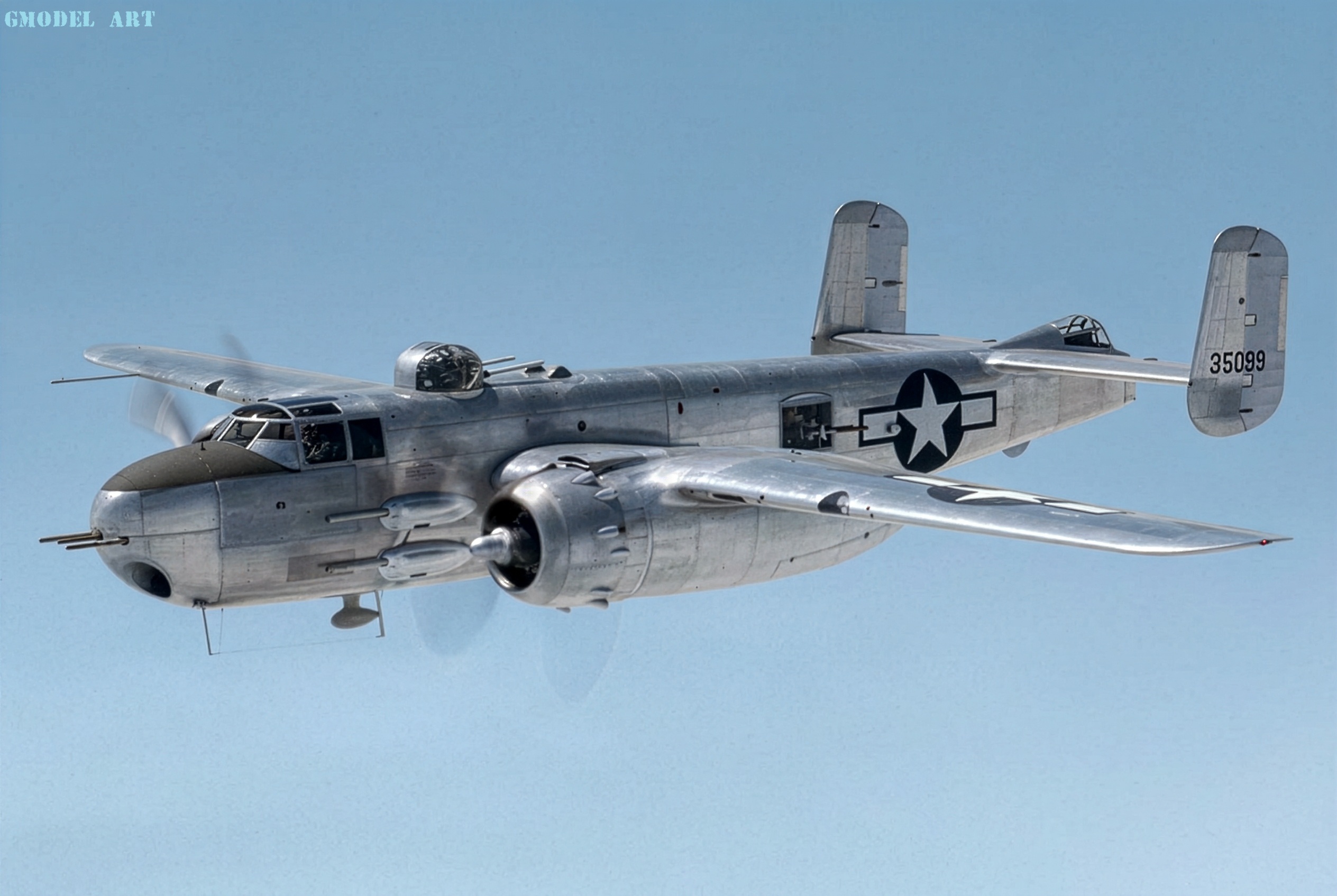
At the same time, the number of machine guns was substantially increased. Four fixed .50-calibre machine guns were installed in the nose, while additional guns were fitted in side-mounted fuselage blisters.
Differences Between Production Batches
The first 300 aircraft featured two .50-calibre machine guns in side blisters on the starboard side of the forward fuselage.
Beginning with serial number 43-4405, two additional machine guns were installed on the port side.
This is one of the most important identification details when distinguishing production configurations.
The aircraft also received a revised rear fuselage arrangement, a dorsal turret moved forward and a new tail armament system.
The Bell M-7 tail turret carried two .50-calibre machine guns. Two additional flexible machine guns were installed at the crew waist positions.
The defensive configuration of later aircraft could include as many as fourteen .50-calibre machine guns, in addition to the 75 mm cannon. The exact total should be checked against the production configuration and the individual aircraft being modeled.
Crew and Internal Layout Changes
One of the important changes was the removal of the co-pilot’s position in the factory configuration. The available space was used as part of the revised crew arrangement and the relocation of the dorsal turret.
The ventral turret was eliminated.
These changes created a distinctive external profile that helps identify the North American B-25H Mitchell when compared with the earlier version.
4. North American PBJ-1G Mitchell and PBJ-1H Mitchell
The US Navy received Mitchell aircraft for operations by the Marine Corps under the PBJ designation.
These designations corresponded to the respective US Army aircraft versions.
North American PBJ-1G Mitchell
Only one North American PBJ-1G Mitchell, BuNo 35097, was delivered to the Navy.
It did not become a mass-production variant or a standard operational type for combat squadrons. It should therefore not be presented as a widely used Gunship version.
North American PBJ-1H Mitchell
The Navy received 248 North American PBJ-1H Mitchell aircraft.
These aircraft were based on the H-model configuration but could display individual differences in radar equipment, antenna arrangements and operational modifications.
Some PBJ aircraft carried APS-3 search radar, with the antenna housed in a dedicated radome beneath the fuselage or at a wingtip, depending on the installation.
The Marines used these aircraft for long-range maritime reconnaissance, anti-shipping attacks and strikes against Japanese positions.
One particularly well-documented aircraft was BuNo 35275, named Love Bug, which served with VMB-613. It was lost during a combat mission over Ponape on 6 February 1945.
The history of this particular aircraft is especially interesting because its serial number, unit, name and armament configuration have been recorded.
5. Operational Units and Combat Service
The 75 mm Gunships were not used by every unit operating the B-25. It is important to distinguish squadrons that flew conventional Mitchells from those that actually received cannon-armed aircraft.
| Unit | Parent Formation | Aircraft | Operational Information |
|---|---|---|---|
| 822nd Bombardment Squadron | 38th Bombardment Group | North American B-25G Mitchell | Operated the G variant in the Southwest Pacific |
| 823rd Bombardment Squadron | 38th Bombardment Group | North American B-25G Mitchell | Entered combat operations with the G variant in October 1943 |
| 11th Bombardment Squadron | Fourteenth Air Force | North American B-25H Mitchell | Used 24 aircraft for operations in China |
| 38th Bombardment Group | Fifth Air Force | North American B-25H Mitchell | Received H-model aircraft in September 1944; exact squadron allocation requires confirmation |
| 341st Bombardment Group | Fourteenth Air Force | North American B-25H Mitchell | Received H-model aircraft in China in 1945 |
| 1st Air Commando Group | Operations in Burma | North American B-25H Mitchell | Used in attack and bombing missions |
| VMB-613 | US Marine Corps | North American PBJ-1H Mitchell | Documented combat operations in the Central Pacific |
The 822nd and 823rd Bombardment Squadrons hold particular importance in the history of the G variant. Their combat experience demonstrated both the capabilities and the limitations of the 75 mm cannon.
The H variant was also used by the 11th Bombardment Squadron in China, where some aircraft were equipped with the APG-13A radar system to improve cannon aiming.
Why the 75 mm Cannon Was Not Adopted by Every Unit
Operational experience showed that the cannon was not always more effective than a powerful battery of machine guns.
Its limited rate of fire, restricted ammunition supply and aiming difficulties during low-level attacks reduced its practical value against several categories of targets.
By August 1944, the use of the heavy cannon had largely been abandoned in the Southwest Pacific. Some aircraft were transferred to other units or returned to technical facilities.
Despite these limitations, the Gunships represented an important chapter in the development of heavily armed attack aircraft.
6. External Differences — A Modeler’s Identification Guide
| Feature | North American B-25G Mitchell | North American B-25H Mitchell |
|---|---|---|
| Main cannon | M4 75 mm | T13E1 75 mm |
| Nose machine guns | Initially 2 × .50 cal | 4 × .50 cal |
| Starboard side blisters | Not a standard factory feature | 2 machine guns |
| Port side blisters | Possible later modifications | Added from serial 43-4405 |
| Dorsal turret | Older rearward position | Moved forward |
| Tail armament | Earlier arrangement, with individual modifications | Twin Bell M-7 turret |
| Waist machine guns | Different configurations | 2 flexible machine guns |
| Ventral turret | Frequently removed | Eliminated |
Important: Operational modifications can make an individual aircraft differ from its original factory configuration. For an historically accurate model, photographs of the specific aircraft and its serial number are essential.
7. Armament Reference Table
| Weapon | North American B-25G Mitchell | North American B-25H Mitchell |
|---|---|---|
| 75 mm cannon | M4 | T13E1 |
| Cannon ammunition | Approximately 21 rounds | Approximately 21 rounds |
| Fixed nose machine guns | 2 × .50 cal | 4 × .50 cal |
| Side-mounted machine guns | Not a standard factory installation | 2 starboard and, on later production batches, 2 port |
| Dorsal turret | 2 × .50 cal | 2 × .50 cal |
| Waist positions | Configuration varied | 2 × .50 cal |
| Tail turret | Configuration depended on the version | 2 × .50 cal |
8. Camouflage and Marking Variations
There was no single standard paint scheme for all 75 mm B-25 Mitchell Gunships.
Many USAAF aircraft operated in the standard wartime camouflage scheme:
Dark Olive Drab on the upper surfaces.
Neutral Gray on the lower surfaces.
Some aircraft were delivered or operated in Natural Metal Finish. Others were repainted or received local finish changes during maintenance.
The following North American B-25H Mitchell examples illustrate different finishes:
Clana Louise, serial 43-4345 — Olive Drab upper surfaces and Neutral Gray undersurfaces.
Dutch, serial 43-4498 — Natural Metal Finish.
Eatin’ Kitty, serial 43-4909 — Olive Drab upper surfaces and Neutral Gray undersurfaces.
For PBJ aircraft, the paint scheme should be verified using photographs of the individual aircraft and the relevant date. It is not accurate to apply one generic Navy paint scheme to every PBJ-1H.
As discussed in my article B-25 PBJ-1 Mitchell: The US Navy and Marines’ Bomber in the Pacific, the Navy operated all three PBJ variants.
Paint Reference Chart
| Colour | Historical Description | Modeling Notes |
|---|---|---|
| Dark Olive Drab | Upper camouflage surfaces on USAAF aircraft | Weathering and fading varied considerably |
| Neutral Gray | Lower camouflage surfaces on USAAF aircraft | Avoid an excessively dark appearance |
| Natural Metal | Unpainted or stripped metal finish | Check photographs of the individual aircraft |
| Interior Green | Common reference for USAAF interior areas | Verify the finish for each compartment and aircraft |
| Black | Propellers and selected details | Yellow propeller tips |
Exact paint matches should be selected from the range of the paint manufacturer being used by the modeler. Federal Standard numbers are not absolute equivalents for every wartime ANA or USAAF colour.
Modeling Guide
9. Available Plastic Kits by Scale
The following kits and releases provide useful starting points for building cannon-armed Mitchell variants.
| Scale | Manufacturer | Kit Number / Reference | Version and Notes |
|---|---|---|---|
| 1/32 | HK Models | 01E00 | Dedicated North American B-25H Mitchell kit |
| 1/48 | Accurate Miniatures | 3432 | North American B-25G Mitchell kit; discontinued |
| 1/48 | Accurate Miniatures | B-25G conversion | Conversion option for compatible B-25B or B-25C/D kits |
| 1/48 | Monogram | 5500 | Older North American B-25H Mitchell release |
| 1/72 | Hasegawa | E17 | North American B-25H Mitchell release; check the box reference and availability |
The 1/48 kit from Accurate Miniatures is an important option for modelers wishing to build the early G variant. Kit number 3432 is specifically associated with this version.
The 1/32 kit from HK Models is the most direct large-scale option for building a North American B-25H Mitchell.
Note: Older kit numbers, conversion references and current availability should be checked against manufacturer catalogues or original kit packaging before purchase.
10. Aftermarket Accessories and Upgrades
1/32 Scale — HK Models
Eduard has released several aftermarket accessories for the HK Models 1/32 kit.
| Manufacturer | Product Code | Description |
|---|---|---|
| Eduard | 32477 | Exterior photo-etched set |
| Eduard | 32996 | Interior photo-etched set |
| Eduard | 33295 | Zoom detail set |
| Eduard | 33296 | Steel seat belts |
| Eduard | JX287 | Painting masks |
| Eduard | JX288 | TFace masks |
| Eduard | 3DL32003 | SPACE 3D detail set |
Art Scale also offers a 1/32 single-sided masking set for the HK Models kit:
Art Scale — 200-M32087 — Canopy and clear-parts masks.
Decals
Eagle Editions released EC#146, a 1/32 decal sheet for the North American B-25H Mitchell.
It includes three aircraft options:
Eatin’ Kitty — 43-4909.
Clana Louise — 43-4345.
Dutch — 43-4498.
The sheet includes markings for specific aircraft and painting information. It is particularly useful because the three options illustrate different camouflage finishes and side-armament configurations.
Availability of older products may vary. Before purchasing, check the manufacturer’s catalogue or specialist model shops.
11. Scratch-Building and Corrections
For an historically accurate Gunship model, the key is to reproduce the correct configuration of the individual aircraft.
Nose and Cannon
Confirm the correct cannon type for the variant.
Reproduce the cannon muzzle opening and the lower nose profile accurately.
Check the number and position of the fixed machine guns.
Cross-reference nose markings and the aircraft serial number.
Side-Mounted Machine-Gun Blisters
For the North American B-25H Mitchell, the serial number is essential.
Aircraft built before serial number 43-4405 had the side-mounted machine-gun blisters on the starboard side, without the factory-installed pair on the port side.
From serial number 43-4405 onward, the port-side blisters were added.
Turrets and Rear Fuselage
The North American B-25G Mitchell retained the older dorsal turret arrangement.
On the North American B-25H Mitchell, the dorsal turret was moved forward.
The H variant received a revised rear fuselage section and a twin-gun tail turret.
Check the waist windows and machine-gun mounting positions.
Radar Equipment
When building a PBJ, the radar installation of the individual aircraft must be examined.
Ventral and wingtip radar housings are not interchangeable details and should not be added without photographic evidence.
B-25 .PBJ-1 Mitchell: The US Navy and Marines’ Bomber in the Pacific (WWII Naval B-25 Guide)
Conclusion
The Mitchell aircraft equipped with 75 mm cannons represent a distinctive chapter in the development of attack aircraft during the Second World War.
The North American B-25G Mitchell introduced the production Gunship concept, while the North American B-25H Mitchell developed it further with a different cannon, revised turret positions and a more powerful machine-gun armament.
The North American PBJ-1H Mitchell carried this concept into Marine Corps operations in the Pacific.
These aircraft are also part of the broader evolution of heavily armed attack platforms, concepts that would later find different expressions in aircraft such as the Fairchild Republic A-10 Thunderbolt II and the Lockheed AC-130. They should not, however, be regarded as direct equivalents or direct design descendants.
For scale modelers, these aircraft offer much more than an unusual nose section. Production differences, operational modifications, camouflage variations and the individual history of each aircraft make them particularly rewarding subjects for historically accurate modeling.
They also offer excellent opportunities for detailed dioramas, with open weapon-access panels, exposed engine sections, extensive mechanical detail and large paintable surfaces. Their operational environments provide plenty of scope for realistic weathering, fading, exhaust staining, chipped paint and other advanced finishing techniques.