article
U.S. Navy Tactical Paint Schemes — History, Aircraft Camouflage and Modeling Guide
The introduction of the U.S. Navy’s Tactical Paint Scheme (TPS) during the late 1970s and early 1980s marked an important change in the appearance of American naval aircraft. Replacing the traditional Light Gull Gray and Insignia White finish, the new camouflage system introduced carefully selected shades of gray, low-visibility markings and aircraft-specific patterns designed to reduce visual detection.
Rather than establishing a single camouflage pattern for the entire fleet, the U.S. Navy developed different applications according to the dimensions, shape and operational role of each aircraft. This approach resulted in several distinctive finishes, including the two-tone and three-tone schemes seen on the A-4 Skyhawk, A-6 Intruder, A-7 Corsair II, F-4 Phantom II, F-14 Tomcat and F/A-18 Hornet.
This guide examines the historical development of the U.S. Navy Tactical Paint Scheme, identifies its four principal Federal Standard colors and explains their application to individual aircraft. It also provides a practical reference for scale modelers selecting accurate paint colors and reproducing the subtle appearance of operational naval aircraft.
Historical Development of the U.S. Navy Tactical Paint Scheme
During the 1970s, the U.S. Navy began reconsidering the effectiveness of its traditional Light Gull Gray and Insignia White camouflage, commonly identified as the LGG/IW scheme. Although widely used throughout the Cold War, the combination of a relatively dark upper surface and a bright white underside could make aircraft easier to distinguish against certain sea and sky backgrounds.
In 1976, the Navy initiated the Tactical Paint Scheme development program to investigate alternative camouflage arrangements. The objective was not simply to make aircraft darker, but to reduce their visual contrast against the surrounding environment and make their identification more difficult.
The program examined different combinations of gray, their placement on the aircraft and the visual effect of irregular camouflage boundaries. Since naval aircraft differed considerably in size, shape and configuration, each type required a specially developed pattern.
The first TPS application was authorized for the new F/A-18A Hornet in July 1980. Further development and operational evaluations continued during 1980–1981.
On April 18, 1985, the U.S. Navy formalized the requirements through MIL-STD-2161(AS), titled Paint Schemes and Exterior Markings for U.S. Navy and Marine Corps Aircraft. The standard established requirements covering exterior colors, marking sizes and their approximate placement.
Subsequent revisions were issued in 1993 (Revision A), 2008 (Revision B) and 2014 (Revision C). Revision C, Change 1, was incorporated on July 5, 2023. The Defense Logistics Agency currently lists this version as active.
The development of TPS can therefore be divided into four important stages:
1976: Development of the Tactical Paint Scheme program begins.
1980–1981: Initial authorizations and operational evaluations.
April 18, 1985: Publication of MIL-STD-2161(AS).
2023: Revision C, Change 1, incorporated into the active military standard.
The Purpose and Principles of Tactical Camouflage
The Tactical Paint Scheme was designed as an aircraft-specific visual camouflage system rather than a universal paint pattern.
Its primary objectives were to reduce the probability and distance of visual detection, reduce the contrast between an aircraft and its background, and make it more difficult for an observer to recognize the aircraft’s type, orientation and number.
Unlike traditional camouflage, which often relied on strong contrasts between different colors, TPS used relatively close shades of gray. These colors were selected to create subtle tonal transitions across the aircraft.
The resulting patterns were intended to disrupt the aircraft’s recognizable outline without producing excessive contrast. Their effectiveness depended on viewing distance, illumination, atmospheric conditions and the background against which the aircraft was observed.
An important distinction is that TPS was primarily a visual camouflage system. It should not be confused with radar-absorbing materials or modern stealth technology.
Another significant development was the introduction of low-visibility external markings. National insignia, identification numbers and other markings were retained but reduced in size and generally applied in subdued shades of gray that contrasted with their immediate background.
The Four Principal Federal Standard Colors
The original U.S. Navy Tactical Paint Scheme palette included four principal Federal Standard colors. They were used in different combinations depending on the aircraft type and approved camouflage pattern.
Listed from lightest to darkest, the colors were:
| Federal Standard | Official Color Name | General Appearance |
|---|---|---|
| FS 36495 | Light Gray | Very light neutral gray |
| FS 36375 | Light Ghost Gray | Light cool gray with a subtle blue-gray character |
| FS 36320 | Dark Ghost Gray | Medium-dark gray with a cool blue-gray character |
| FS 35237 | Blue Gray | Darker blue-gray |
Light Gray — FS 36495
FS 36495 is the lightest color in the principal TPS palette. It was used in selected early camouflage arrangements, most notably on the underside of the initial F/A-18A scheme and on certain other aircraft applications.
It provides a noticeably lighter appearance than FS 36375, although the difference can become less obvious under strong sunlight or after operational weathering.
For scale modeling, excessive contrast between FS 36495 and FS 36375 can make the finish appear less natural than it does on full-size aircraft.
Recommended GModel Art reference: Mr. Color C-338 — Light Gray FS 36495.
Light Ghost Gray — FS 36375
FS 36375 is one of the most frequently encountered colors in U.S. Navy tactical camouflage.
It was used on the lower surfaces of numerous aircraft and, depending on the approved pattern, also covered portions of the fuselage sides, wings, vertical stabilizers and engine intake areas.
Its appearance is a cool light gray, with a subtle blue-gray character. It is particularly important when reproducing the characteristic low-contrast separation between the lighter and darker TPS shades.
Paint reference: FS 36375 — Available Modeling Paints.
Dark Ghost Gray — FS 36320
FS 36320 is the darker counterpart to FS 36375 and became one of the defining colors of modern U.S. Navy and U.S. Air Force aircraft camouflage.
It was commonly used on upper surfaces and, in certain aircraft-specific patterns, on the sides of the fuselage and vertical stabilizer.
Although darker than FS 36375, the two colors are relatively close in appearance. Their separation should remain subtle, particularly on aircraft photographed after extended operational service.
Paint reference: FS 36320 — Available Modeling Paints.
Blue Gray — FS 35237
FS 35237 is the darkest of the four principal TPS colors.
Its distinctive blue-gray appearance makes it particularly useful for reproducing the darker upper surfaces of selected aircraft, as well as the anti-glare areas immediately forward of the cockpit.
Unlike the Ghost Gray combination, FS 35237 generally creates a more noticeable visual separation from the lighter gray surfaces.
Recommended GModel Art reference: Mr. Color C-337 — Blue Gray FS 35237.
Tactical Paint Schemes by Aircraft Type
Although the same four principal colors formed the basis of the system, their distribution varied considerably between aircraft.
The following sections describe the characteristic U.S. Navy camouflage arrangements and distinguish the principal schemes from later variations.
A-4 Skyhawk — Three-Tone Tactical Camouflage
The A-4 Skyhawk used a distinctive three-tone TPS arrangement.
The principal colors were:
FS 36320 Dark Ghost Gray: Applied to the main upper surfaces.
FS 36375 Light Ghost Gray: Used to interrupt the darker areas, including much of the vertical fin, trailing portions of the wings and horizontal stabilizers, as well as selected lower fuselage areas.
FS 36495 Light Gray: Applied to the underside.
The resulting pattern created a combination of darker upper surfaces and lighter sections distributed across the airframe.
The transition between the three shades was particularly noticeable around the fuselage and tail surfaces.
For modelers, it is important to follow the correct aircraft-specific pattern rather than simply painting the entire upper fuselage FS 36320 and the underside FS 36495.
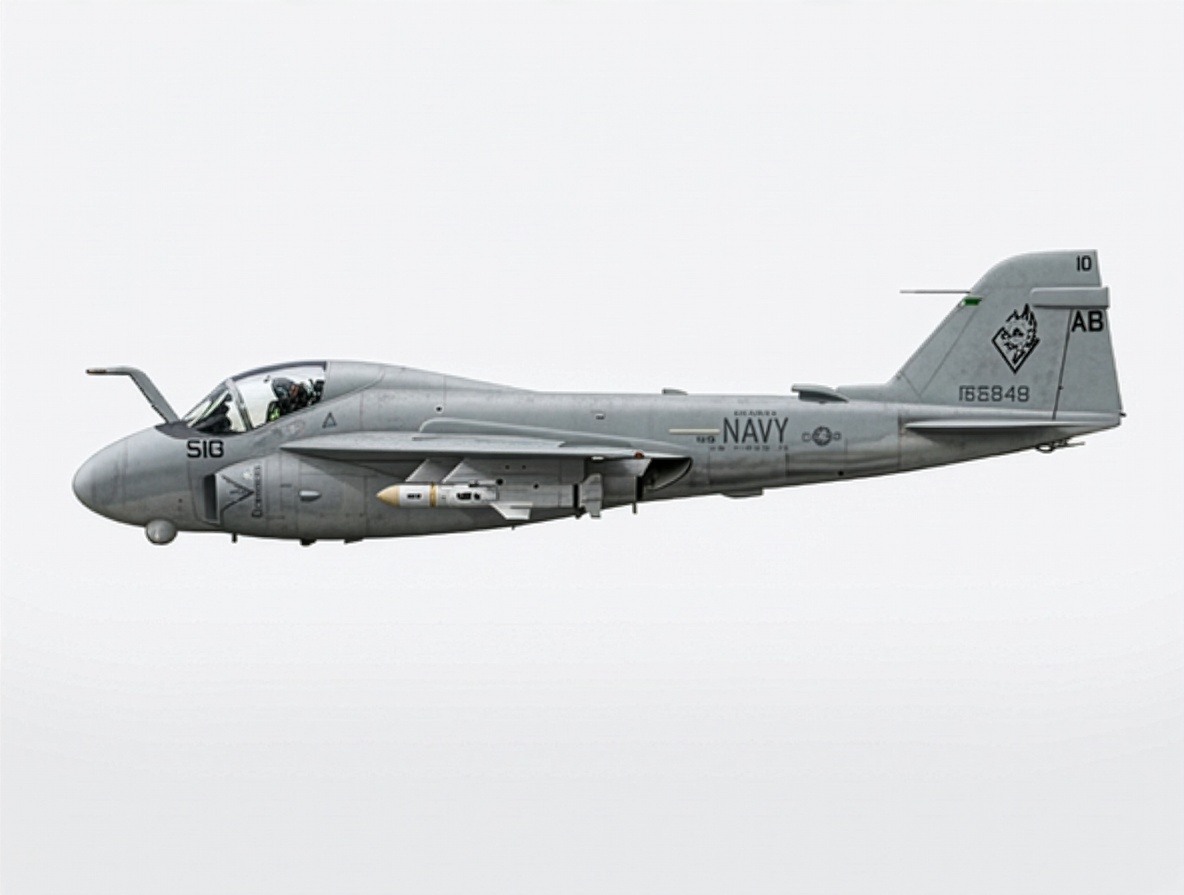
A-6 Intruder — Two-Tone Tactical Camouflage
The A-6 Intruder adopted a relatively straightforward two-tone arrangement.
FS 36320 Dark Ghost Gray covered the upper surfaces, while FS 36375 Light Ghost Gray was applied to the fuselage sides and undersides.
An important identifying feature was the use of FS 36375 on approximately the forward third of the wings.
This arrangement produced a relatively simple pattern while maintaining the low-contrast appearance characteristic of the Tactical Paint Scheme.
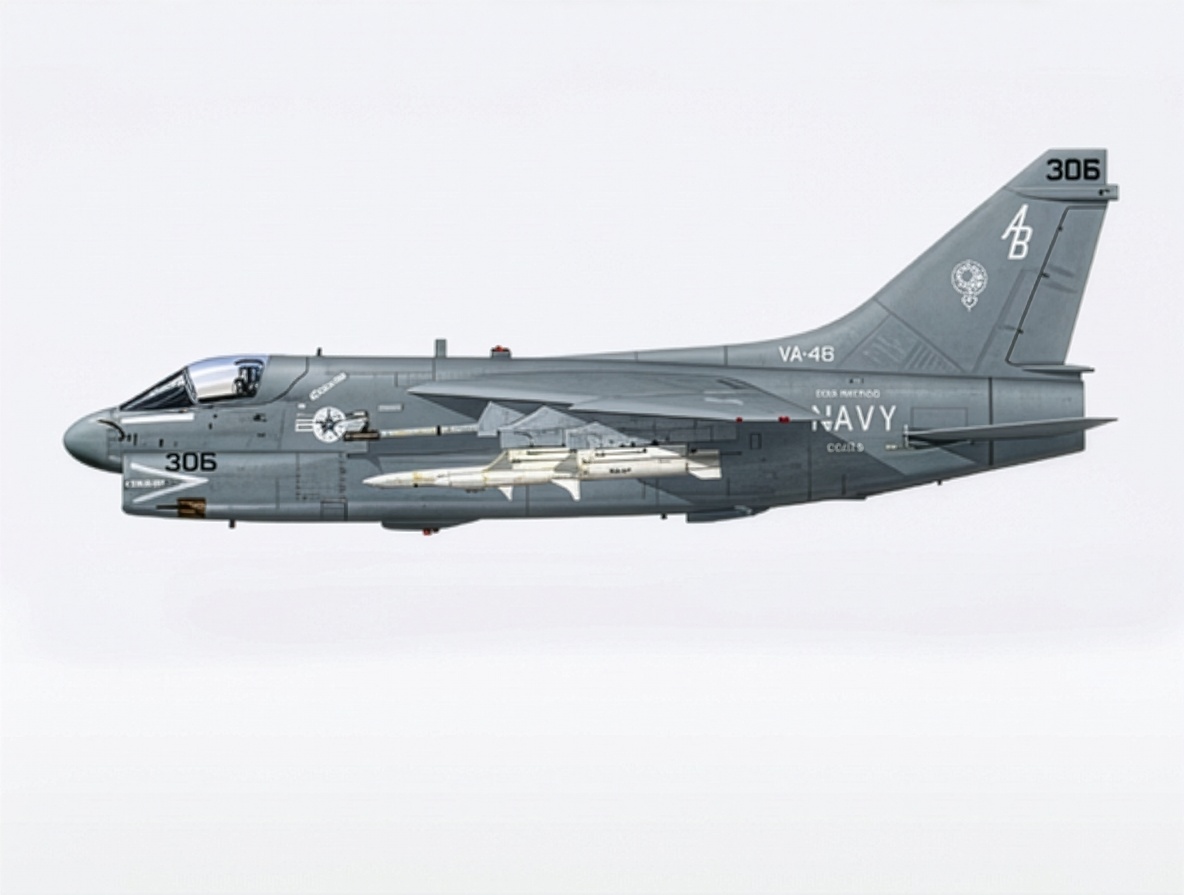
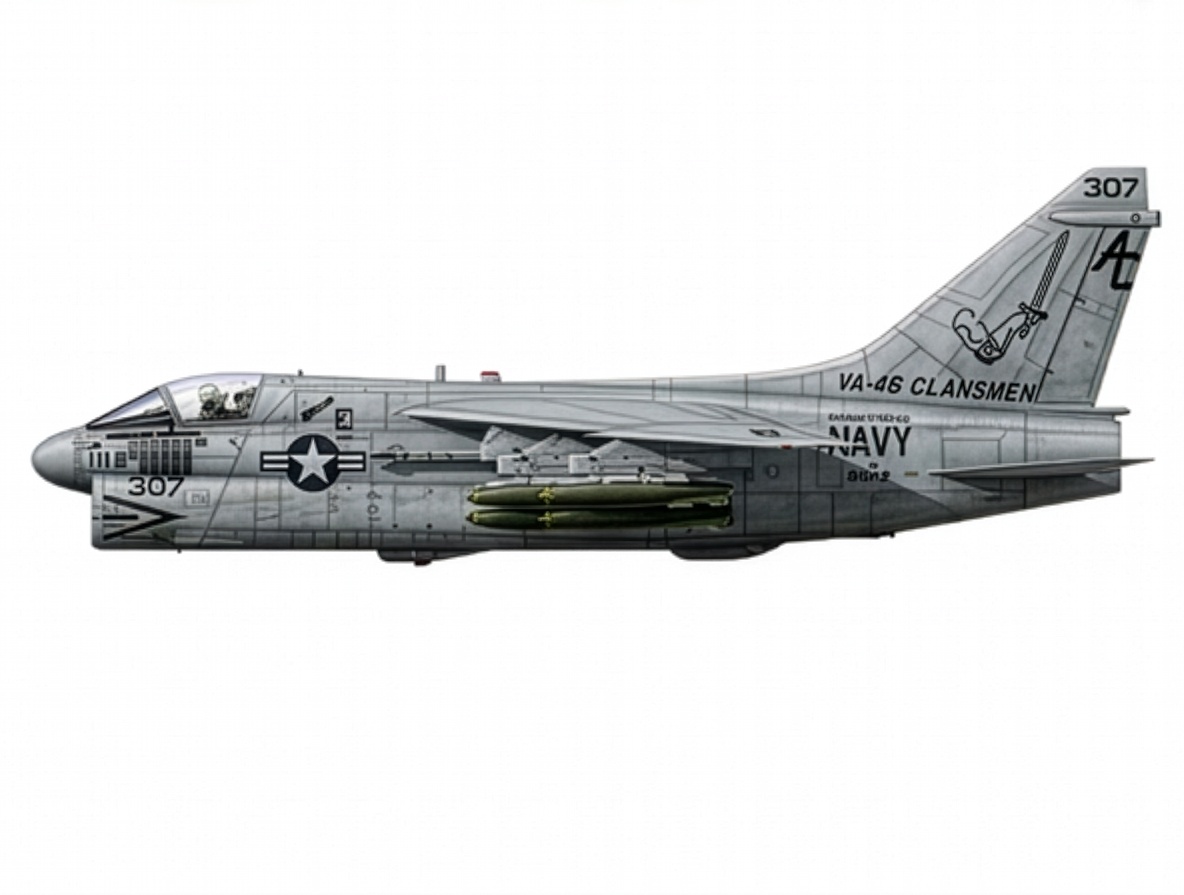
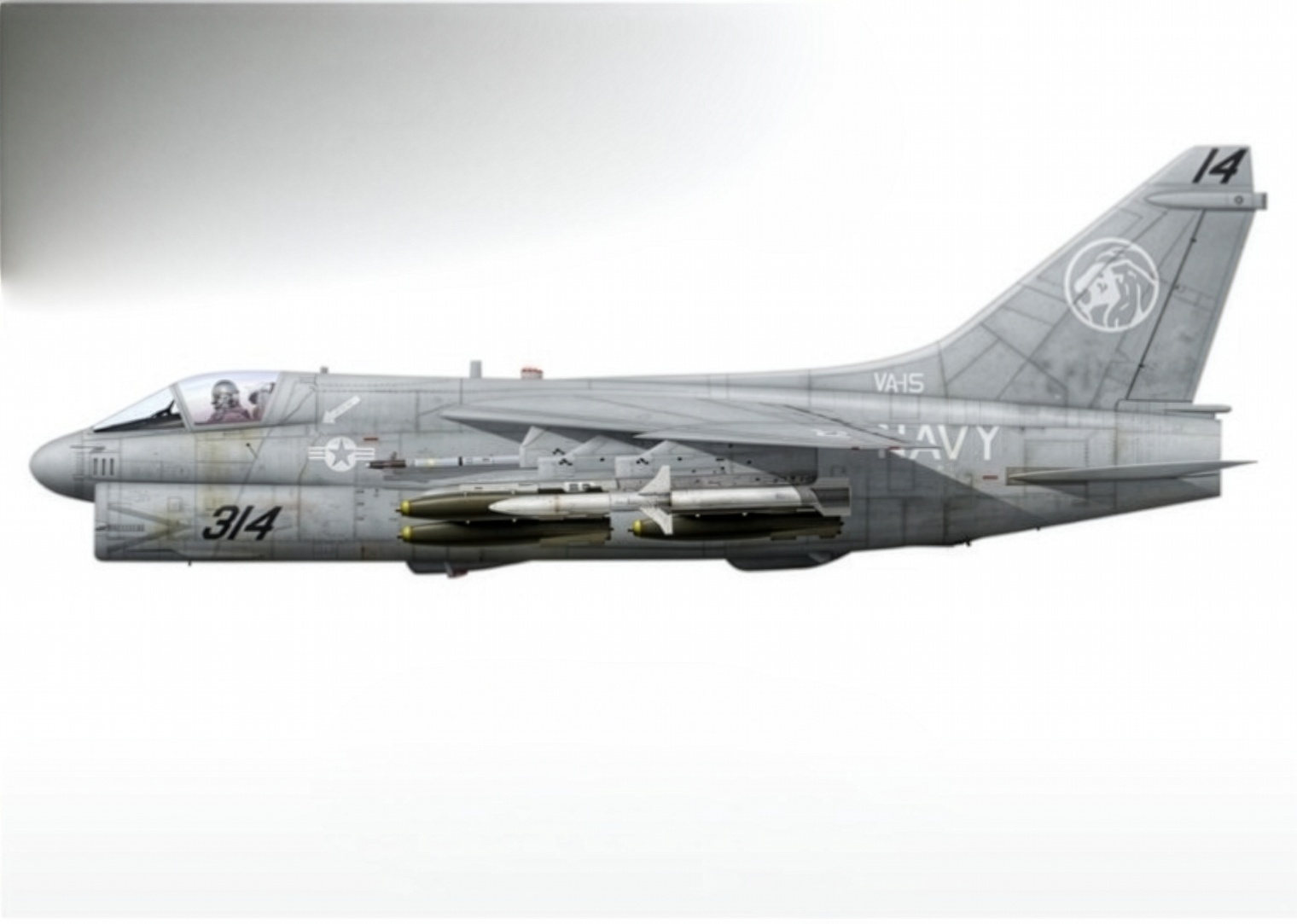
A-7E Corsair II — Low-Visibility Two-Tone Scheme
The U.S. Navy A-7E Corsair II used a predominantly two-tone tactical camouflage pattern.
The principal arrangement consisted of:
FS 36320 Dark Ghost Gray: Upper surfaces.
FS 36375 Light Ghost Gray: Lower surfaces and selected areas along the fuselage sides.
The boundary between the two colors curved upward along the fuselage beneath the wings rather than following a simple horizontal line.
Although FS 36495 is also associated with early and limited TPS applications, the standard two-tone Corsair II pattern is generally represented by FS 36320 and FS 36375.
For accurate modeling, the specific aircraft, unit and period should be checked against photographic references.
F-4 Phantom II — Three-Tone Navy Tactical Camouflage
Late-service U.S. Navy Phantom II aircraft adopted a distinctive three-tone gray camouflage system.
The characteristic F-4S Navy Tactical Paint Scheme used:
FS 35237 Blue Gray: Upper surfaces.
FS 36320 Dark Ghost Gray: Fuselage sides and vertical stabilizer.
FS 36375 Light Ghost Gray: Lower surfaces.
The darker blue-gray upper surface created a clear tonal separation from the medium-gray sides, while the lighter underside completed the three-tone arrangement.
On the F-4S, the meeting point of the darker camouflage areas around the nose is an important feature to reproduce accurately.
Some U.S. Marine Corps Phantom variants displayed different arrangements. During the late 1980s, examples were photographed with FS 36118 Medium Gunship Gray on their upper surfaces. This was a separate variation rather than one of the four principal Navy TPS colors.
Modelers should therefore avoid treating every late-service F-4J, F-4S or Marine Corps Phantom as having an identical camouflage pattern.
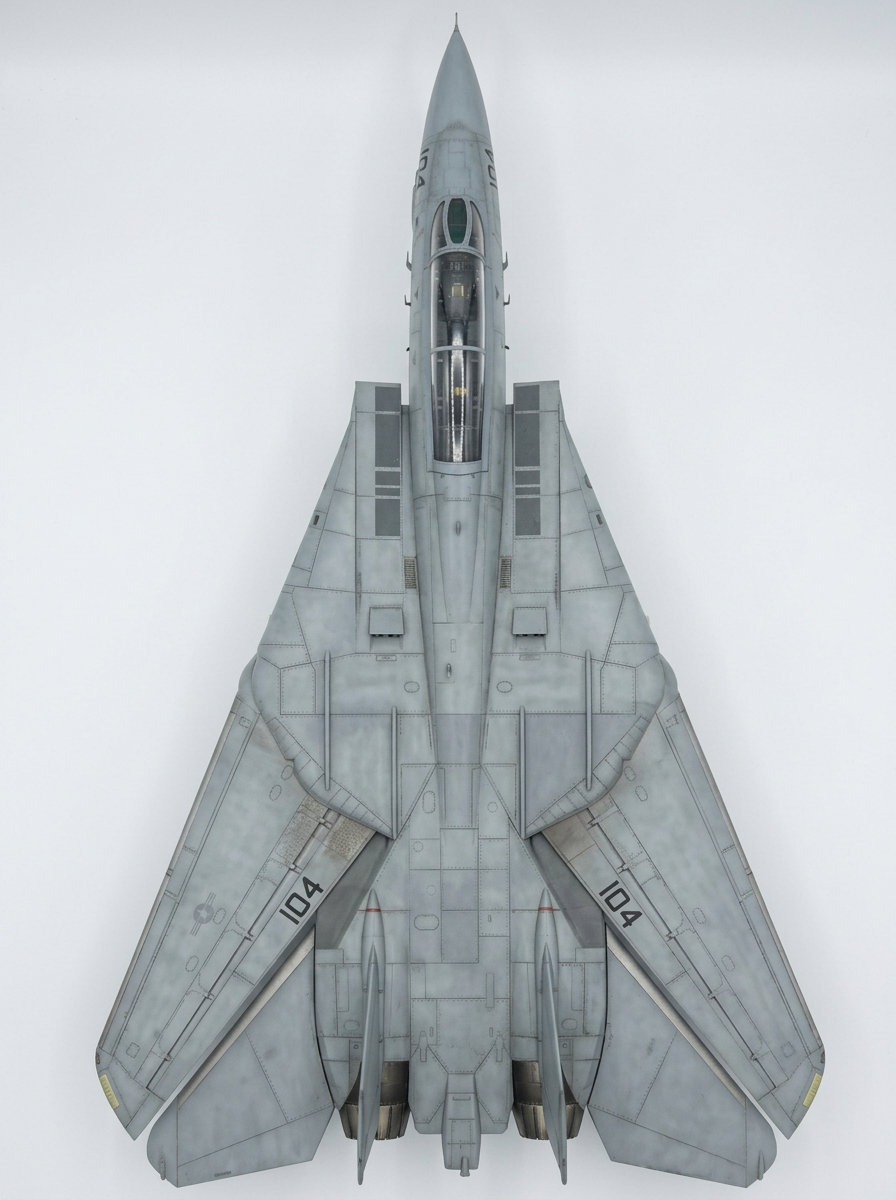
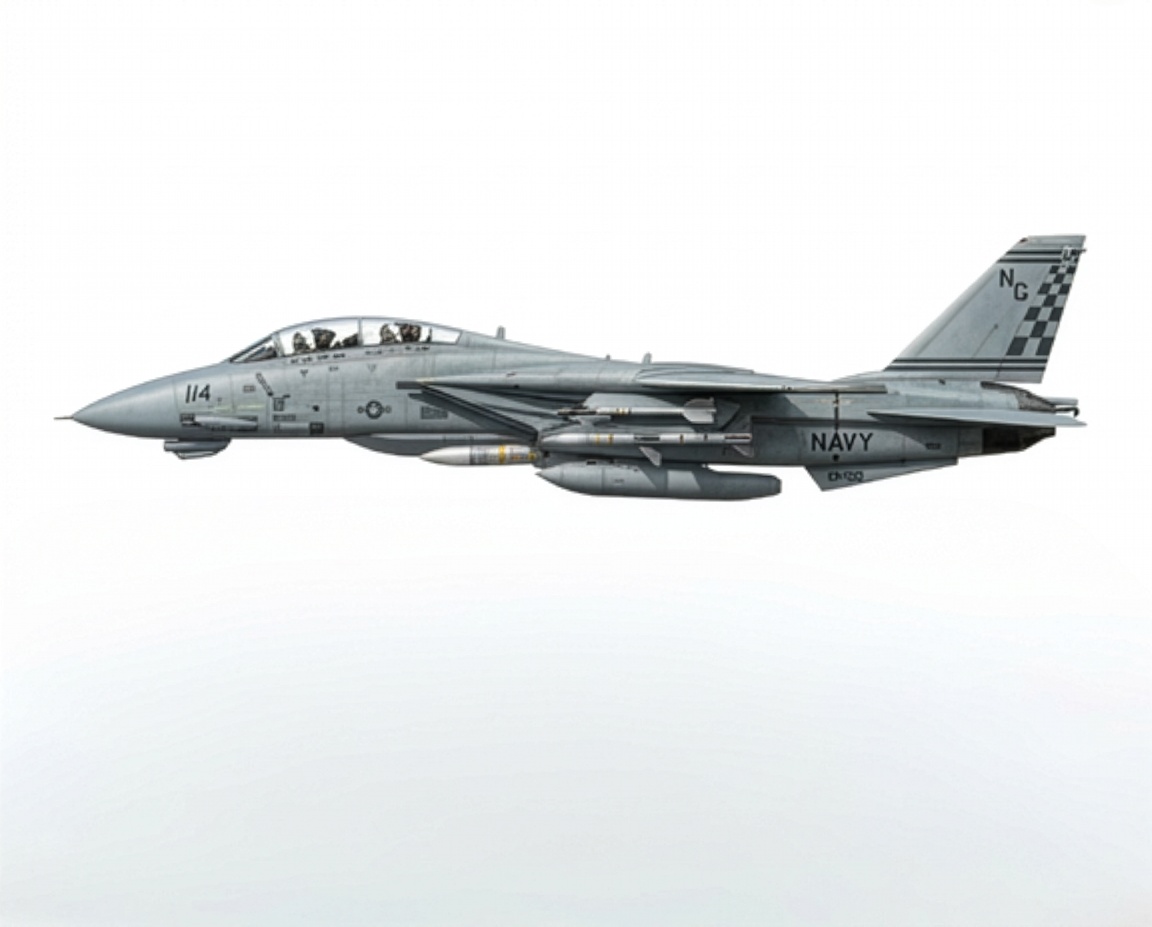
F-14 Tomcat — Three-Tone Tactical Paint Scheme
The F-14 Tomcat adopted one of the most recognizable three-tone applications of the U.S. Navy Tactical Paint Scheme.
The earlier arrangement consisted of:
FS 35237 Blue Gray: Upper surfaces.
FS 36320 Dark Ghost Gray: Fuselage sides and vertical stabilizers.
FS 36375 Light Ghost Gray: Undersides.
FS 36375 also extended around the engine intake areas, with the camouflage boundary curving upward along the forward fuselage.
The two darker colors met near the forward section of the aircraft, producing a characteristic camouflage pattern around the nose.
During the 1990s, the arrangement evolved on later-service aircraft. FS 36320 became the principal upper-surface color, while FS 35237 was retained mainly in the anti-glare area ahead of the cockpit.
This distinction is especially important when modeling different F-14A, F-14B and F-14D aircraft from different periods. The exact application should always be checked against photographs of the individual aircraft.
F/A-18 Hornet — The First TPS Hornet
The F/A-18A was the first aircraft for which the new U.S. Navy Tactical Paint Scheme was formally authorized.
Its original finish differed from the later, familiar Hornet camouflage.
The early arrangement consisted of:
FS 36375 Light Ghost Gray: Upper surfaces.
FS 36495 Light Gray: Undersides, including the intake areas and radome.
FS 35237 Blue Gray: Anti-glare area forward of the cockpit.
The early pattern also included characteristic transitions along the nose and between the wings and horizontal stabilizers.
The later two-tone arrangement, associated particularly with the F/A-18C and subsequent fleet appearances, used:
FS 36320 Dark Ghost Gray: Upper surfaces.
FS 36375 Light Ghost Gray: Lower surfaces.
The demarcation around the forward fuselage also changed. The later arrangement generally followed a more streamlined boundary extending from the leading-edge extension area towards the radome.
For accurate scale modeling, the early F/A-18A and later F/A-18C camouflage patterns should not be treated as interchangeable.
S-3 Viking — Overall Light Ghost Gray
The S-3 Viking used one of the simplest TPS arrangements among the aircraft covered in this guide.
The main external finish was FS 36375 Light Ghost Gray, applied across nearly the entire aircraft.
The area immediately forward of the cockpit was generally finished in FS 35237 Blue Gray as an anti-glare surface.
Some aircraft used FS 37038 Black in this area instead.
Unlike the three-tone arrangements seen on the F-14 or F-4S, the S-3 relied primarily on a single gray color with a contrasting cockpit anti-glare panel.
Radome Tan — FS 33613 and Protective Coatings
During the transition to low-visibility camouflage, protective coatings continued to be used on the radomes of several U.S. Navy aircraft.
One of the most recognizable finishes was Radome Tan FS 33613, a tan-colored protective coating frequently seen on aircraft such as the A-6 Intruder, F-14 Tomcat, F/A-18 Hornet and S-3 Viking.
In some cases, a similar finish was also visible on the tips of external fuel tanks.
This protective coating should not be considered a fifth standard TPS camouflage color. It was a separate finish associated with the requirements of particular radomes and other components.
Its use became less widespread during the 1990s, although individual examples continued to display variations in radome color.
When building a model, the radome should therefore be researched separately from the main camouflage pattern. A tan radome should not automatically be added to every aircraft wearing TPS colors.
Model Paint Accuracy and Federal Standard Color Matching
Reproducing U.S. Navy Tactical Paint Schemes requires careful attention to the relationship between the four principal FS colors.
Although the colors are individually well documented, commercially available modeling paints do not always reproduce their appearance in exactly the same way.
Differences in pigment composition, paint formulation, finish and weathering can influence the final result.
The most demanding combination is usually FS 36320 Dark Ghost Gray and FS 36375 Light Ghost Gray.
These colors are relatively close in tone, and an excessive difference between them can make a model look more contrasting than the full-size aircraft.
FS 36495 — Light Gray
FS 36495 is widely represented by different modeling paint manufacturers.
However, some paint samples appear slightly lighter or warmer than expected, occasionally showing a faint beige character.
This can create an excessive difference between FS 36495 and FS 36375 when both colors are applied to the same model.
For a convincing result, the two shades should be evaluated together rather than individually.
FS 36375 and FS 36320 — Ghost Gray Comparison
The combination of Light Ghost Gray and Dark Ghost Gray requires particular attention.
Some commercially available paints can appear too neutral, too dark or slightly too purple compared with the intended blue-gray character.
The most important factor is not simply selecting two paints labeled with the correct FS numbers. It is achieving the correct relationship between their hue, lightness and contrast.
Comparative model paint references have identified differences among Gunze, AK Real Colors, Lifecolor, Hataka, Mission Models, AMMO, Vallejo, Xtracolor and other ranges.
Some combinations reproduce the general hue reasonably well but exaggerate the contrast between the two colors. Other samples appear too neutral or show a noticeable color shift.
MRP paints have also received favorable assessments in comparative modeling references for their balance of hue and tonal separation.
These comparisons should be treated as practical modeling assessments rather than laboratory certification. Paint formulations and production batches can change, and final appearance is also influenced by the model’s surface preparation, varnish and weathering.
FS 35237 — Blue Gray
FS 35237 is generally easier to evaluate visually because its darker blue-gray appearance creates a more noticeable contrast against the Ghost Gray colors.
Nevertheless, differences between paint manufacturers can still affect its appearance.
Some samples can appear too dark, while others lack sufficient blue and appear closer to neutral gray.
For a convincing result, FS 35237 should retain its characteristic blue-gray appearance without becoming excessively blue or almost black.
Modeling Paint Reference Chart — U.S. Navy TPS
The following table provides useful paint references for the four principal Tactical Paint Scheme colors.
| FS Reference | Color | Mr. Color | AK Real Colors | MRP |
|---|---|---|---|---|
| FS 36495 | Light Gray | C338 | RC253 | MRP-364 |
| FS 36375 | Light Ghost Gray | C308 | RC252 | MRP-38 |
| FS 36320 | Dark Ghost Gray | C307 | RC251 | MRP-97 |
| FS 35237 | Blue Gray | C337 | RC237 | MRP-105 |
These are reference matches from comparative modeling paint guides. They should be checked against the individual manufacturer’s current catalog before purchase.
For modelers using Gunze/Mr. Color, the following references provide a convenient starting point:
C-338 — Light Gray FS 36495.
C-308 — Light Ghost Gray FS 36375.
C-307 — Dark Ghost Gray FS 36320.
C-337 — Blue Gray FS 35237.
The correct paint selection should always be considered alongside the aircraft’s specific camouflage pattern and service period.
Applying TPS Colors to Scale Models
The appearance of a Tactical Paint Scheme on a scale model depends on more than choosing the correct Federal Standard colors.
The subtle nature of the original camouflage requires careful painting, controlled weathering and appropriate surface finishing.
Color Demarcation
The difference between FS 36320 and FS 36375 should remain relatively subtle.
Avoid creating an excessively sharp contrast simply to make the camouflage pattern more visible. The original aircraft often displayed relatively soft-looking tonal differences, particularly after operational wear and exposure to the elements.
Surface Finish
The characteristic appearance of TPS aircraft was generally associated with subdued, low-sheen finishes.
A suitable matte or restrained satin finish is therefore preferable to a highly glossy appearance when reproducing the operational camouflage.
The correct finish should nevertheless be checked against the specific aircraft and period being modeled.
Operational Weathering
Aircraft operating from aircraft carriers were exposed to salt, moisture, hydraulic fluids, fuel, maintenance activity and frequent cleaning.
These conditions produced variations in the finish, including:
Subtle fading of exposed upper surfaces.
Localized differences in gray tones across individual panels.
Fluid stains and maintenance marks around service panels.
Exhaust staining around engine outlets.
Minor paint wear around access panels and frequently handled areas.
Weathering should remain controlled. Excessive fading or artificial contrast can obscure the characteristic low-visibility appearance of TPS camouflage.
Scale Effect
At smaller scales, a perfectly matched full-size color may appear too dark or too intense.
A restrained adjustment in lightness may help reproduce the visual impression of the original aircraft, but the adjustment should preserve the recognizable character of each FS color.
The goal is not to change the historical color reference, but to reproduce how that color appears on a scale model.
U.S. Navy Helicopter Tactical Paint Schemes
The Tactical Paint Scheme concept was also adopted by U.S. Navy helicopters during the 1980s and subsequent decades.
However, helicopter applications should not be confused with the specific arrangements used on fixed-wing combat aircraft.
A representative helicopter scheme used:
FS 35237 Blue Gray: Upper surfaces directly exposed to the sky.
FS 36375 Light Ghost Gray: Fuselage sides.
FS 36495 Light Gray: Undersides.
The three colors were selected to create a subdued appearance from different viewing angles.
The SH-60 Seahawk is one of the most recognizable aircraft associated with this approach. The SH-3 Sea King also received updated gray camouflage during the transition to modern low-visibility finishes.
An important exception was the MH-53E Sea Dragon, which retained a darker overall finish associated with FS 36081 Dark Gunship Gray.
This demonstrates that the TPS concept was adaptable to aircraft roles and operational requirements rather than being restricted to one universal pattern.
A Lasting Standard in Naval Aviation
The U.S. Navy Tactical Paint Scheme represented an important step in the evolution of military aircraft camouflage.
Its development replaced the traditional high-contrast gray-and-white finish with a more adaptable system based on low-visibility colors, aircraft-specific patterns and subdued external markings.
From the distinctive early F/A-18A configuration to the three-tone F-14 Tomcat and F-4S Phantom schemes, TPS created some of the most recognizable naval aircraft appearances of the late Cold War.
For scale modelers, understanding the historical development and correct distribution of the Federal Standard colors is essential to reproducing these aircraft accurately.
The four principal colors — FS 36495, FS 36375, FS 36320 and FS 35237 — remain important references when researching and modeling U.S. Navy tactical aircraft.
The most accurate result comes from combining reliable color references, period photographs and the correct camouflage diagram for the individual aircraft.
Key Questions for Scale Modelers
What does TPS mean in U.S. Navy aircraft camouflage?
TPS stands for Tactical Paint Scheme. It refers to an aircraft-specific camouflage system developed by the U.S. Navy to reduce visual detection and improve the aircraft’s ability to blend into its operational environment.
When was the U.S. Navy Tactical Paint Scheme introduced?
The program began in 1976. The first TPS application was authorized for the F/A-18A in July 1980, while the formal military standard MIL-STD-2161(AS) was issued on April 18, 1985.
What are the four principal U.S. Navy TPS colors?
The four principal colors are Light Gray FS 36495, Light Ghost Gray FS 36375, Dark Ghost Gray FS 36320 and Blue Gray FS 35237.
Which FS colors are used on the F-14 Tomcat?
The earlier three-tone pattern used FS 35237 on the upper surfaces, FS 36320 on the sides and FS 36375 on the undersides. Later arrangements used FS 36320 over most upper surfaces, retaining FS 35237 mainly around the cockpit.
What colors were used on the F-4S Phantom II?
The characteristic Navy F-4S Tactical Paint Scheme consisted of FS 35237 on the upper surfaces, FS 36320 on the fuselage sides and FS 36375 on the undersides.
What is the difference between the early and later F/A-18A camouflage?
The early F/A-18A used FS 36375 on the upper surfaces and FS 36495 underneath, with FS 35237 around the cockpit. Later Hornet schemes generally used FS 36320 above and FS 36375 below.
Is Radome Tan FS 33613 part of the four-color TPS palette?
No. FS 33613 was used as a separate protective coating on selected radomes and other components. It was not one of the four principal TPS camouflage colors.
F-14A Tomcat VF-84 Jolly Rogers 1/48 HobbyBoss Build – Ultimate Weathering & Painting Guide
Which modeling paints can be used for U.S. Navy TPS colors?
Mr. Color, MRP, AK Real Colors and other manufacturers offer paints corresponding to the principal FS references. Modelers should compare the actual shades and their relative contrast before applying them to the entire model.
The following table summarizes the schemes above:
| Cockpit | Upper | Sides | Lower | |
| A-4 Skyhawk | ||||
| 36320 | 36375 | 36495 | ||
| A-6 Intruder | ||||
| 36320 | 36375 | 36375 | ||
| A-7E Corsair II | ||||
| 36320 | 36320 | 36375 | ||
| F-4J/S Phantom II | ||||
| 35237 | 36320 | 36375 | ||
| F-4J/S Phantom II (USMC) | ||||
| 36118 | 36320 | 36375 | ||
| F-14A Tomcat | ||||
| 35237 | 36320 | 36375 | ||
| F-14D Tomcat | ||||
| 35237 | 36320 | 36375 | 36375 | |
| F/A-18 Hornet | ||||
| 35237 | 36375 | 36495 | 36495 | |
| F/A-18 Super Horner | ||||
| 36320 | 36375 | 36375 | ||
| S-3 Viking | ||||
| 35237 | 36375 | 36375 | 36375 |
| FS 36495 | FS 36375 | FS 36320 | FS 35237 | |
| Light Gray | Light Ghost Gray | Dark Ghost Gray | Blue Gray | |
| Scheme | ||||
| TPS | (Lower) | (Lower) | (Upper) | (Upper) |
| Color matches | ||||
| Gunze Aqueous | H338 | H308 | H307 | H337 |
| Gunze Mr Color | C338 | C308 | C307 | C337 |
| Humbrol | 147 | 127 | 128 | 145 |
| Model Master | 1732 | 1728 | 1741 | 1721 |
| Revell | – | – | – | – |
| Tamiya | – | – | – | – |
| Vallejo Model Air | 71.276 | – | 71.120 | 71.114 |
| Vallejo Model Color | – | 70.615 | – | 70.905 |
| AKAN | – | 72032 | 72030 | 72043 |
| AK Interactive | – | AK 2057 | AK 2058 | AK 2056 |
| AK Real Colors | RC253 | RC252 | RC251 | RC237 |
| AMMO by Mig | A.MIG-209 | A.MIG-203 | A.MIG-208 | A.MIG-210** |
| Colourcoats | – | ACUS03 | ACUS40 | ACUS38 |
| Hataka | HTK-_050 | HTK-_037 | HTK-_035 | HTK-_046 |
| Lifecolor | UA 023 | UA 026 | UA 027 | UA 145** |
| Mission Models | MMP-116 | MMP-073 | MMP-074 | MMP-072 |
| Mr Paint | MRP-364 | MRP-38 | MRP-97 | MRP-105 |
| Xtracolor | X139 | X136 | X135 | X126 |
| Xtracrylix | XA1139 | XA1136 | XA1135 | XA1126 |
https://www.wikiwand.com/en/articles/McDonnell_Douglas_F/A-18_Hornet
article